Showing posts with label settlements. Show all posts

Wednesday, December 14, 2011

Israeli democracy 'shackling freedoms' says FT

“In recent weeks, the country has been consumed by an anguished debate over a series of new laws and proposals that many fear are designed to stifle dissent, weaken minority rights, restrict freedom of speech and emasculate the judiciary. They include a law that in effect allows Israeli communities to exclude Arab families; another that imposes penalties on Israelis advocating a boycott of products made in West Bank Jewish settlements; and proposals that would subject the supreme court to greater political oversight.”
so writes Tobias Buck, Jerusalem correspondent for the Financial Times.  He adds that, despite the coarsening of domestic political discourse that has unleashed fury and dismay inside the Jewish state, 
"the chances of Israel turning into a dictatorship are about as high as those of Saudi Arabia turning into a liberal democracy."

Faint praise, indeed. When rightwing Israeli extremists attack the IDF troops who are pledged to protect them in the West Bank, as happened yesterday, the mind boggles at their warped vigilante notion of "price tag." The entire country pays the coast of their shortsighted actions.

 Israelity bites.

Tuesday, August 16, 2011

Unsettling Statistics for Israeli Economy


Peace Now, the grassroots organization, has long maintained that settlements and the occupation are both a moral and economic blight on Israel. Here are the statistics to prove it, from a business study by the OECD (Organization for Economic Cooperation & Development) :

"The inclusion of the settlements and east Jerusalem adds about 4% to Israel's gross domestic product, but reduces the GDP per capita by a significant rate of 6.5% a year"

When east Jerusalem, West Bank settlements and Golan Heights are figured in with Israel's overall economic statistics, per capita income is reduced while inequality is increased. With the settlement population growing nearly one hundred percent between 1997 and 2009 (most recent population figures), this does not bode well for the future of the country and the street protestors griping about prices and opportunities. Sever Plocker analyses the stats in Ynet news. One wag says "gross domestic product" is a good caption for the photo above!


Wednesday, February 23, 2011

Up on the Roof of a Caged House


The al-Ghirayib family lives in one of the stranger manifestations of Israel's 43-year occupation of the West Bank: a Palestinian house inside a metal cage inside an Israeli settlement. The family's 10 members, four of them children, can only reach the house via a 40-yard (meter) passageway connecting them to the Arab village of Beit Ijza below. The passage passes over a road frequented by Israeli army jeeps and is lined on both sides with a 20-foot-high (6-meter) heavy-duty metal fence.
In this Associated Press photo taken Wednesday, Feb. 9, 2011 a Palestinian boy sits on his rooftop near the fenced-in house of al-Ghirayim family, between the Jewish settlement of Givon Hahadasha and the West Bank village of Beit Ijza.
Hat tip to Angela for this image.

Sunday, November 21, 2010

Checkpoint: Backscatter Fears and Naked Aggression


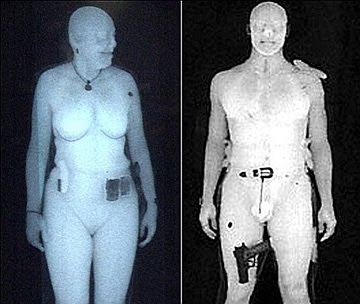
"Don't touch my junk" has a corollary: don't zap my gonads with radiation, either.

Americans on the go are increasingly upset about the intrusiveness of pre-boarding security checks at their airports, whether by full-body scanner or an enhanced pat-down grope. Perhaps lessons can be learned by examining the health effects on Palestinians who have for years submitted to similar security checks.

More than a quarter million Palestinians live in the shadow of the Israeli's separation barrier, particularly in spots where the barrier is jig-sawed to protect hilltop settlers in what they refer to as Judea and Samaria. Ostensibly to deter terrorists, a tall electrified fence and trench system disconnects many Palestinian families living in such isolated rural pockets from their families and jobs in the West Bank. (Gaza is entirely corralled, and any patients and accompanying medical staff who are permitted to leave the enclave undergo such body scans as well.) In order for West Bank residents to reach jobs outside these restricted zones, to see friends and relatives, shop, or even make bank deposits, an Israeli-issued permit is required. All permit-holders must line up to be checked by private Israeli armed security guards or national border police before they are allowed past the separation barrier.

Crossing the Reihan/Bartaa checkpoint into the rest of the West Bank entails a full body backscatter x-ray scan, using machines similar to the bulky TSA scanners at 68 American airports which have raised the hackles of travelers this month.

Like US pilots who object to any extra doses of radiation caused by these virtual strip-searches, many Palestinian women are reluctant to undergo full-body scans twice a day, repeatedly. Even though their refusal denies them access to work or to harvest family fields that lie on the other side of the barrier, many resist.

Three years ago, I interviewed more than a dozen women at a basic health clinic in Um el Reihan run by a Western foreign aid agency. Each one said she was too scared to enter a foreign-built machine that might endanger a pregnancy or reduce her fertility.

Dr Muthanna Jabbarin , who tends the day clinic inside Um el Reihan and returns to Jenin at dusk a couple of days per week, is bothered that he has no access to data about the security equipment and the radiation hazard of malfunctions. He's unable to reassure worried patients who must go through the scanning machine twice daily about possible cancer risks. Several miscarriages, including one suffered by a woman in her eighth month, have raised his concerns. The doctor believes that the heat, the prolonged standing, and the anxiety all take a toll on expectant mothers.

In such a conservative community, many people feel violated because the security apparatus can see through their clothing and records each fold of flesh. Scars from, say, a Caesarean birth or a circumcision will be readily apparent on the screen. Every one of these scans is scrutinized by young Israeli guards. Fears that the images will be kept or photographed on mobile phones and uploaded to the internet are widespread. Numerous Palestinian seamstresses, teachers, and students have abandoned the commute from their Um el Reihan enclave into the West bank to avoid the public humiliation. Now they are marooned in this tiny hamlet which receives no services from either the Palestinian authority or the Israeli government.

Not only are the 350 Palestinian residents of Um el Reihan unable to cross the old Green Line west of their village to enter Israel but, but even if they go east and stand on line for hours, many are delayed or prevented from visiting the rest of the Palestinian territory. Reihan/Bartaa checkpoint, with its requisite body scans and searches, has mutated this little community into a Mid-Eastern gulag. After the Transport Security Administration's latest controversy over backscatter strip searches and groin-thumping frisks, a few more jet-setting Americans may empathize with the plight of these folks in the West Bank.

Jan McGirk was a special correspondent reporting from Gaza and the West Bank for The Lancet, a British medical journal. Crossposted on The Huffington Post.

Wednesday, July 28, 2010

Settlement spook 'outed' in US Newspaper


Hagit Ofran documents Israeli settlement growth in the West Bank with a pocket-sized camera and a deep sense of mission, often making news well beyond Israel.Her grandfather, the philosopher Yeshayahu Leibovich, taught her that Israelis deserved the oxymoronic epithet 'Judeo-Nazis' if they continued encroaching and settling. Ben Lynfield follows the sleuth.

Hagit Ofran's official title is director of the Settlement Watch Team of the dovish Peace Now organization. In practice, she is a spy operating in hostile territory, snooping, sniffing, and piecing together bits of intelligence to gauge how much illicit building is going on.

On a recent scouting trip, Ofran spotted four new trailers spread like matchboxes on a hillside of the Alon settlement northeast of Jerusalem.

The prefabricated buildings are in effect helping to fragment the heartland of a future Palestine. ''It's not that one caravan will change the chances of Middle East peace,'' says Ofran. ''But another and another and another will determine whether we can have a two-state solution to the conflict or not.''
Fluent in Arabic – and well-versed in sleuthing

Israel's conservative government now faces a crucial decision over whether or not to extend a 10-month partial freeze on settlement building that expires in September. The Obama administration is pressing for the freeze to remain in place, but Prime Minister Benjamin Netanyahu's right-wing coalition partners want it scrapped to enable a wave of new building.

''If it is not extended then the freeze may have delayed a few hundred sites for months, but it will not have caused a real change,'' Ofran says.''If work is restarted it might mean that the chances of peace are doomed, at least with this government.''

A fluent Arabic speaker, Ofran sometimes is tipped off by Palestinians about new settler building. She pores over aerial photos commissioned by Peace Now, whose settlement watch unit is funded partly by the governments of Britain and Norway, and garners information from planning meetings and official documents.

In March, Ofran learned from the Jerusalem municipality's website that officials had given permits for settler building at the Shepherds Hotel site in East Jerusalem, which is predominantly Arab. She did not keep the information to herself – though she's tight-lipped about her exact role...Settlements, though
government-sponsored, lacks transparency. Much of its activity is illegal even according to Israeli law and settler leaders prefer to avoid public debate over it. Construction also violates the Geneva Convention and runs counter to international commitments Israel made to halt settlement building, for example in the 2003 international peace blueprint known as the road map. Tellingly, there is no distinct budget for building at settlements.

Saturday, April 17, 2010

Why Palestine is not on the map

Here's a video explanation/simplification now making the rounds... as if Israeli-Palestinian relations were talked about much inside American classrooms. It's worth watching this clip to see a Palestinian perspective and to realize that any two-state approach to peace is being eroded by Israeli settlement policy in the West Bank and East Jerusalem. Comments?
(Hat tip to Michael Bailey for the you tube link)

Thursday, April 10, 2008

Blair's Middle-East muddling and double standards


Chris Patten, co-chairman of International Crisis Group and chancellor of Oxford U, is no slouch on international affairs. His recent comments on the distracted performance of Middle East envoy Tony Blair in the performance of his "initial day job" are frank and cut close to the bone. The goal is "a peaceful Palestinian state next door to a secure Israel in a region united in prosperity and stability." How to achieve this remains a conundrum, and Blair's own brand of shuttle diplomacy, spending only a few days a month on this daunting task, will not yield any Northern Ireland-style breakthroughs. An excerpt follows:


... Blair has just made a useful comment on Palestine and Israel, which deserves to be taken seriously. Throughout the long years of this bloody tragedy, we have tried to inch our way to a settlement through confidence-building measures or, in the case of the long dead "road map," through pushing both parties to take parallel steps toward an agreement. Some observers, not least hard-headed Israeli peace campaigners, have suggested a different approach.

You will never succeed, they say, if you try to bob and weave your way slowly toward an end game. Instead, you should jump straight into a final deal. And, since you won't get the two sides to agree to it, you'll have to impose it from the outside.

But that ambitious outcome is easier described than achieved. While Israeli public opinion has usually appeared to run well ahead of its political leaders in the approach to peace, it is difficult to see how one could act over their heads. They need to be pushed and shoved into a successful negotiation. What would it mean to go straight to Palestinian statehood?

Presumably, Blair is not proposing to the Palestinians the creation of a state before an agreement is reached on final borders. There cannot be a Palestinian state without dealing with West Bank settlements. If you don't believe me, just visit the West Bank and see, for example, how the proposed suburban Israeli development of East Jerusalem stabs through the heart of Palestinian territory toward the Dead Sea. How can you have a viable state carved up by fences, military roads, and barbed wire?

Any Palestinian state should be within the 1967 borders (as adjusted through negotiation). Peace activists on both sides solved that in the Geneva initiative. Yasser Arafat and Ehud Barak came close to doing so at Camp David almost eight years ago.

Moreover, a Palestinian state would not only comprise the West Bank and Gaza, but presumably would also have to accommodate the principal political parties in each area. Attempts to destroy Hamas — whether politically or physically — have not worked and cannot work. The Americans and Europeans committed a major error in conspiring to destroy the Fatah-Hamas national unity government, which was created largely thanks to the diplomacy of Saudi Arabia and other Arab League countries.

I hope that Blair is saying that to his American friends. His greatest achievement was the peace deal in Northern Ireland. That historic triumph depended on bringing in Sinn Fein politicians — leaders of the Irish Republican movement who in many cases could not be distinguished from the IRA, which bombed, shot, and maimed civilians in pursuit of its political goals.

Why should what worked in Northern Ireland — indeed, what was pressed on Britain by the United States — be unthinkable in the Middle East? Are we in the West guilty of double standards yet again?

I abhor any and every terrorist act, by Hamas or anyone else. I have had friends killed by terrorists. But since when were sentiment and moral denunciation sufficient ingredients of a policy? And when did a disproportionate military response to terrorism ever work?

The third challenge in establishing a Palestinian state is to create the institutions of statehood: Hospitals, ports, airports, roads, courts, police stations, tax offices, and government archives. When I was a European commissioner, we provided funds from European taxpayers to pay for these things. Then we saw them systematically trashed by Israel's response to the second Intifada.

How did destroying driving licenses in Palestine preserve Israeli security? How was it preserved by digging up runways, uprooting olive trees, and fouling wells?

A Palestinian state will need to be built from the bottom up. And what is built should not be destroyed.

Tuesday, April 17, 2007

Pulitzer Prize Picture is Unsettling

This powerful shot of a lone settler woman resisting a squadron of Israeli police who were ordered to carry out evictions last year has won the world-renowned Pulitzer prize for news photography. Mozel tov to an intrepid Israeli wire photographer, Oded Balility.

But does this image show defiance or something else? Is this an idealist or a stubborn criminal? Every picture tells a story...and this one cuts to the quick of the contentious struggle over homeland inside the Holy Land.

(Photo above is copyrighted by Oded Balilty, of Associated Press.)

Friday, April 06, 2007

No Go: Jerusalem Tram Plan Trammelled?


Getting around inside Jerusalem unobstructed is almost impossible, except on foot. Drivers face sudden improvised barriers, detours, closed lanes, potholes,and shallow ditches. An ambitious one-way road system keeps getting rejigged and rerouted before drivers can work it out. Local cynics insist that it's designed to enrage and frustrate car owners so they'll be willing to park and ride the city's new Light Railway once it is up and running in 2009. For now, parked cars, straddling the curbs, block most sidewalks. The city buses run sporadically, are too wide for narrow inner streets, and must share the roadway with enormous tourist coaches. Reliable public transportation--if it can be kept safe from attackers-- would be a godsend for Jerusalemites. Envisioned by Theodor Herzl back in 1900, a city rail transport plan was finally signed into existence a century later by then-mayor Ehud Olmert. He's now the Prime Minister, and the least popular man in the country.

Citypass consortium is contracted to build and run the long-awaited light rail project in Jerusalem.If it can ease the traffic snarls and improve the humour of impatient drivers, that will be viewed as a minor miracle. Tempers have been fraying for months as construction workers get stuck in. With streets torn up and constantly re-piped and repaved, no one seems to know how to avoid bottlenecks.

But there is yet another stumbling block. Two French companies, Veolia Transport and Connex, hold contracts for the tramway's construction and are being sued in Paris. It's political, with suggestions that the city fathers plan an apartheid railway, with separate carriages likely for Arab-Israelis, and severe restrictions against any Palestinian riders. Prosecutors allege that "Israel was exploiting international and regional crises to create a new permanent reality in Jerusalem and its vicinity, expanding the settlements, building the separation fence and constructing the light rail." The pro-Palestinian plaintiff insists that a conspiracy is underway to "turn the settlements that are located close to Jerusalem into Jewish neighborhoods of the city, facilitating transport to and from these settlements and encouraging more people to live there" because of the quick link to downtown.

Creating Israeli strongholds in Arab parts of Jerusalem will further isolate the east Jerusalem neighborhoods from the West bank, the lawyers charge. The project will expropriate land from Arabs for parking lots and some rail routings.

Under union pressure, a Dublin firm called Veolia Transport Ireland has balked at the project. It abruptly cancelled plans to train Israeli personnel.Dublin's union drivers refuse to allow their transport system to be used by drivers destined for a new tram system linking the illegal Israeli settlements in East Jerusalem. “It’s not going to happen”, trade union official John Flannery said.

In November the Dutch ASN Bank decided to divest from Veolia until the company respects the relevant UN resolutions. Meanwhile, the streets of Jerusalem are in disarray as railway workers pickaxe the pavement again and again.


Graffiti daubed on construction sites for the tramway in downtown Jerusalem. Snaps by JMcG