Showing posts with label Israelis. Show all posts

Sunday, November 21, 2010

Checkpoint: Backscatter Fears and Naked Aggression
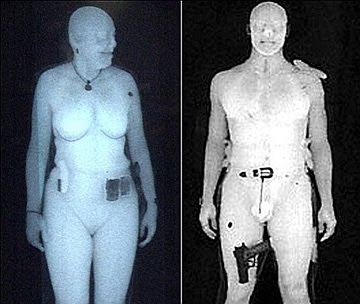

"Don't touch my junk" has a corollary: don't zap my gonads with radiation, either.

Americans on the go are increasingly upset about the intrusiveness of pre-boarding security checks at their airports, whether by full-body scanner or an enhanced pat-down grope. Perhaps lessons can be learned by examining the health effects on Palestinians who have for years submitted to similar security checks.

More than a quarter million Palestinians live in the shadow of the Israeli's separation barrier, particularly in spots where the barrier is jig-sawed to protect hilltop settlers in what they refer to as Judea and Samaria. Ostensibly to deter terrorists, a tall electrified fence and trench system disconnects many Palestinian families living in such isolated rural pockets from their families and jobs in the West Bank. (Gaza is entirely corralled, and any patients and accompanying medical staff who are permitted to leave the enclave undergo such body scans as well.) In order for West Bank residents to reach jobs outside these restricted zones, to see friends and relatives, shop, or even make bank deposits, an Israeli-issued permit is required. All permit-holders must line up to be checked by private Israeli armed security guards or national border police before they are allowed past the separation barrier.

Crossing the Reihan/Bartaa checkpoint into the rest of the West Bank entails a full body backscatter x-ray scan, using machines similar to the bulky TSA scanners at 68 American airports which have raised the hackles of travelers this month.

Like US pilots who object to any extra doses of radiation caused by these virtual strip-searches, many Palestinian women are reluctant to undergo full-body scans twice a day, repeatedly. Even though their refusal denies them access to work or to harvest family fields that lie on the other side of the barrier, many resist.

Three years ago, I interviewed more than a dozen women at a basic health clinic in Um el Reihan run by a Western foreign aid agency. Each one said she was too scared to enter a foreign-built machine that might endanger a pregnancy or reduce her fertility.

Dr Muthanna Jabbarin , who tends the day clinic inside Um el Reihan and returns to Jenin at dusk a couple of days per week, is bothered that he has no access to data about the security equipment and the radiation hazard of malfunctions. He's unable to reassure worried patients who must go through the scanning machine twice daily about possible cancer risks. Several miscarriages, including one suffered by a woman in her eighth month, have raised his concerns. The doctor believes that the heat, the prolonged standing, and the anxiety all take a toll on expectant mothers.

In such a conservative community, many people feel violated because the security apparatus can see through their clothing and records each fold of flesh. Scars from, say, a Caesarean birth or a circumcision will be readily apparent on the screen. Every one of these scans is scrutinized by young Israeli guards. Fears that the images will be kept or photographed on mobile phones and uploaded to the internet are widespread. Numerous Palestinian seamstresses, teachers, and students have abandoned the commute from their Um el Reihan enclave into the West bank to avoid the public humiliation. Now they are marooned in this tiny hamlet which receives no services from either the Palestinian authority or the Israeli government.

Not only are the 350 Palestinian residents of Um el Reihan unable to cross the old Green Line west of their village to enter Israel but, but even if they go east and stand on line for hours, many are delayed or prevented from visiting the rest of the Palestinian territory. Reihan/Bartaa checkpoint, with its requisite body scans and searches, has mutated this little community into a Mid-Eastern gulag. After the Transport Security Administration's latest controversy over backscatter strip searches and groin-thumping frisks, a few more jet-setting Americans may empathize with the plight of these folks in the West Bank.

Jan McGirk was a special correspondent reporting from Gaza and the West Bank for The Lancet, a British medical journal. Crossposted on The Huffington Post.

Tuesday, June 01, 2010

Israelis don snorkels to show support for commandos in botched flotilla raid


Israelis wearing snorkels attend a demonstration in support of Israel following a deadly raid by Israel's navy on an aid flotilla bound for the blockaded Gaza Strip, outside the Turkish embassy in Tel Aviv, Israel, Monday, May 31, 2010. (Hat tip to the BBC)

Thursday, June 19, 2008

Beating the odds: organ transplants across the political divide


This is an extraordinary tale,despite the rather dry translation. One Palestinian teenager dies of wounds after a confrontation with security , and his parents approve that his healthy organs be transplanted into half a dozen ailing Israelis. All names are kept under wraps to prevent reprisals by extremists who would harm the teenaged donor's relatives or the Israeli recipients who now owe their lives to what some would term "shaheed organs".

In "Two Peoples, One Heart", published in the Hebrew daily Ma’ariv, reporter Dan Even reports about a rare Palestinian-Israeli organ transplant:

An 18 year-old Palestinian was injured a few weeks ago in an incident with Israeli security guards. He was taken to the intensive care unit at Sheba Medical Center at Tel-Hashomer, where the doctors fought for his life, but after a week he was pronounced brain dead. In spite of the incident his parents agreed to donate his organs, which saved the lives of no less than six Israelis.
The young man’s parents accepted the request from the staff of the hospital and the National Center for Transplants and Donation of Organs. At the transplants center the identity of the donor was kept secret so as not to endanger his parents, who live in one of the towns in the territory of the Palestinian Authority. The recipients of the organs were also informed that the family of the donor wished to remain anonymous. Yesterday, however, just a few hours after he heard the story, one of the recipients met the father of the donor, who had donated his heart. The emotional meeting was held at the hospital and the two embraced, shook hands, and formed a close friendship, which transcends the borders of the Israeli-Palestinian conflict and will link the families for ever.
The meeting took place in the same room where a few weeks ago the father received the bad news that his son, “A”, had died. In the previous few months, “A” had been the main provider for his family, because his father had fallen sick. “He was an amazing man,” the father told Ma’ariv. He said he did not hesitate to donate the organs of his son to Israelis, even though his son was killed in an incident with Israelis. “At first it was very difficult for me,” he said, “but I received my inspiration from God. I am at peace with my decision to this day.”

Thursday, August 30, 2007

Sudanese Migrants' Exodus to Israel

Hundreds of Sudanese migrants who have crossed the southern desert on foot into Israel now are imprisoned in the so-called Promised Land. And, despite Israel’s pledge to evaluate each case individually, 48 new arrivals were summarily expelled this month immediately after they were caught. The trickle of mostly Muslim asylum-seekers from Africa has become a flood and created a crisis of conscience inside Israel, where security concerns routinely override compassion. Al-Qaeda is active in the Sudan, and this raises alarms.

Some Israelis argue that,after the horrors of the Nazi genocide in Europe, it is morally reprehensible for Israel’s Jews to turn away people fleeing from persecution. Memories of relatives who were refused asylum in the 1930s and sent back to be part of the Final Solution are still excruciating. Around 70 desperate Africans sneak across Israel's barren southern border every night to seek refuge among sympathetic Jews.

But pragmatic politicians warn that Israel, with its population of 7 million, could soon be engulfed by up to 3 million Sudanese. The majority fled from the brutal savagery of civil war and drought-ravaged lands years ago and now seek a softer life in Israel; they want to escape racist abuse and maltreatment in Egypt.

“Israel puts these people at grave risk by expelling them with no proper procedure and no indication of Egypt’s willingness to accept them,” warned Bill Frelick, the refugee policy director for Human Rights Watch. Many have escaped from war-blighted Darfur, travelled north through Chad or Egypt, and had hoped to remain temporarily in Israel until resettled in a third-country.

Sending an illegal migrant back to Sudan after he has visited Israel, an enemy nation, is tantamount to a death sentence.

Last month, the Israeli Prime Minister Ehud Olmert promised asylum to 500 refugees who escaped the horrors of Darfur, but the burgeoning numbers have numbed public sympathy. Government spokesman David Baker clarified that “The policy of returning back anyone who enters illegally will pertain to everyone, including those from Darfur.” Olmert insists that President Hosni Mubarak personally assured him Egypt will safeguard Sudanese who are sent back; but concerns heightened after a tv interview with an Israeli soldier who witnessed Egyptian troops beating and shooting dead four Sudanese refugees trying to slip across the border on August 1st.

Mustafa, a laborer who fled Darfur six years ago and was unhappy living in Cairo, has been under ‘house arrest’ on an Israeli kibbutz for the past year, earning a wage to send home to his relatives in Sudan while his case is reviewed. Other African ‘prisoners’ are assigned jobs at beach resorts in Eilat. Workers are needed to replace the Palestinians now prevented from reaching their jobs by checkpoints and the security wall. Though prohibited from leaving the workplace, Sudanese refugees manage to earn reasonable salaries inside Israel. Word has spread, not by bush telegraph but by cell phone. In 2004 the the United Nations registered just five Sudanese here; Until 2006, with the intifada at full tilt, few asylum seekers would consider Israel. Now, sixty or seventy refugees cross into Israel each night; activists estimate that at least 3000 are inside the country.

Mustafa , age 31, dreads the day he gets deported. He still has nightmares after Egyptian immigration police locked him up for ten days in a cramped jail because he had no documents. “That place is unimaginable,” he recalled recently. “Fifty of us were curled up, very hot, like cooking meat, and everybody was smoking, shouting....It ‘s difficult for a human being to endure vermin crawling over you while you are still alive.”

At great risk, Mustafa took a hand-drawn map of Sinai and set out alone for Israel, which he considers the first outpost of the West.
Bedouin smugglers are willing to spirit refugees across the 132 mile-long frontier, along with prostitutes and drugs, but they can charge able-bodied men $1000 a head. Women pay $600.

Mustafa trekked alone all night through dunes and scrub, but he neglected to bring any drinking water. By journey’s end, his thirst drove him to turn himself in at an Israeli checkpoint. “When I thought of the water, I forgot everything,” he admitted, Israeli soldiers are under orders to arrest stray illegals they encounter in the desert. Security forces and police must make sure illegal aliens get a medical check-up for dehydration before rounding them up and locking them away in Khetziot Prison, a remote desert jail close to the Egyptian border. Men are kept apart from their families here.

Few of the Sudanese women prisoners planned on a permanent move to Israel, observed Anat Hoffman, director of the Israel Religious Action Center,a Reform organization which has launched an outreach program to African refugee families. “They’ve heard so much about Israel in the news, they imagine it’s a huge place, maybe not quite so big as Europe, but just as important," she said. "No one wants our free Hebrew-Arabic dictionaries; they prefer to learn English and eventually to end up in America. They think of the US as the magic place where people of color have a chance. Condi Rice seems like some powerful black queen to them.“

"No one can expect that Israel alone can be the solution for all the Darfur refugees, and we urge the international community to act decisively. Israel is willing to play her part in the framework of international efforts," a Foreign Ministry statement spelled out. A single Messianic Jew in the Negev has erected shelter for 50 Sudanese refugees, according to the Economist.
In contrast to the government's dithering, many private Israelis have been generous. A Jerusalem-based religious group seeks to help the small minority of non-Muslim refugees who, if deported to an Arab country, would come under intense pressure to convert. Christian Sudanese refugees are at particular risk. Egyptian interrogators acting under Sudanese security service supervision routinely torture them to extract intelligence about who else might be reverting to Christianity.

Charmaine Hedding, a spokeswoman for the Christian Embassy, a pro-Zionist Evangelical group, suggested that a number of churches in America would welcome Sudanese Christians sent on from Israel. "Let us relocate these people; 1,000 people is manageable," she said.

Meanwhile, while volunteers try to firm up the arrangements, another seventy desperate Sudanese will evade Egyptians and slip through the desert border into Israel every night.

NOTE: UNRWA officials asked that names be disguised to protect the refugees while their status is determined. Guest post, copyright Jan McGirk, 08/21/2007
.......