Showing posts with label Syria. Show all posts

Thursday, May 19, 2011

Tel Aviv Pole-sitter Challenges Blaine


The latest high profile endurance stunt in Tel Aviv's Rabin Square is not overly ambitious, given a historic view. True, Israeli illusionist Hezi Dean wants to outdo Brooklyn's Trump-financed endurance artist, David Blaine, and be hailed as a Hebrew Houdini. So Hezi Dean was cranked up on a 27 meter high tower in Tel Aviv yesterday morning and aims to remain there with no food until Thursday evening, for a total of 35 hours. He plans to jump off into a stack of cardboard boxes to break his fall.

Meh.

The feats of an ascetic Syrian Christian saint, Symeon the Stylite the Elder, were far more impressive! Symeon lived and prayed for 37 YEARS - not hours- on a small platform perched atop a 15 meter high pillar near Aleppo--way back in the third century. Shepherd boys sometimes scrambled up with hunks of bread,cheese,and sips of water. And Symeon, a true pillar of his community, inspired many imitators to sit on a pedestal too. He still holds the Guinness World Record for longest pole sit. For Blaine and Dean, he's a tough act to follow.

Thursday, April 23, 2009

Horrors - Ancient Arms Caches along Sinai's Way of Horus, claims Haaretz


Worryingly close to Rafah, archaeologists have uncovered huge weapons caches in the Sinai, at least according to a report published in today's Haaretz newspaper. It then recaps an agency reporter's tale about 4 Egyptian temples found along the Road of Horus. Reading beteen the lines, it seems that there were no actual weapons left to be found, but impressively big buildings with enough room to store them. Speculative reporting like this shows the same skewed logic that assumed a warehouse in Syrian wasteland which had been visited by North Koreans must hold a nuke reactor and should be secretly obliterated by the IDF. True, too many present day weapons get smuggled into Gaza along these ancient military routes, and then by burrowing under the border fences. Perhaps the headline writer couldn't resist the usual newsy phrases, particularly since the announcement, four months after arrests, that the Sinai was Hezbollah's latest hotspot for plotters.

Arms Storehouse Uncovered in Sinai


Archaeologists exploring an old military road in the Sinai have unearthed four new temples amidst the 3,000-year-old remains of an ancient fortified city that could have been used as a stronghold during the Egyptian occupation of Mesopotamia and Canaan, and to impress foreign delegations visiting Egypt, antiquities authorities announced Tuesday.

Archaeological findings have determined that a series of fortresses were built in the area and were used as weapons storehouses for soldiers traveling northwards. One source, a wall painting found in the Karnak temple in Luxor, depicts 11 strongholds built in northern Sinai

Among the discoveries was the largest mud brick temple found in the Sinai with an area of 70 by 80 meters (77 by 87 yards) and fortified with mud walls 3 meters (10 feet) thick, said Zahi Hawass, chief of Egypt's Supreme Council of Antiquities.

The find was made in Qantara, 2 1/2 miles (4 kilometers) east of the Suez Canal. These temples mark the latest discovery by archaeologists digging up the remains of the city on the military road known as "Way of Horus." Horus is a falcon-headed god, who represented the greatest cosmic powers for ancient Egyptians.

The path once connected Egypt to Palestine and is close to present-day Rafah, which borders the Palestinian territory of Gaza. Archaeologist Mohammed Abdel-Maqsoud, chief of the excavation team, said the large brick temple could potentially rewrite the historical and military significance of the Sinai for the ancient Egyptians.

The temple contains four hallways, three stone purification bowls and colorful inscriptions commemorating Ramses I and II. The grandeur and sheer size of the temple could have been used to impress armies and visiting foreign delegations as they arrived in Egypt, authorities said.

The dig has been part of a joint project with the Culture Ministry that started in 1986 to find fortresses along the military road. Hawass said early studies suggested the fortified city had been Egypt's military headquarters from the New Kingdom (1569-1081 B.C.) until the Ptolemaic era, a period lasting about 1500 years.

In a previous find, archaeologists there reported finding the first ever New Kingdom temple to be found in northern Sinai. Studies indicated the temple was built on top of an 18th Dynasty fort (1569-1315 B.C.).

Last year, a collection of reliefs belonging to King Ramses II and King Seti I (1314-1304 B.C.) were also unearthed along with rows of warehouses used by the ancient Egyptian army during the New Kingdom era to store wheat and weapons.

Thursday, May 22, 2008

Urgent Email from Ersatz Israel


Hmmm...could there perhaps be a Nigerian twist in this sleazy tale of Slim-Fast and fat envelopes?
According to Jameel, over at the clever Muqata blog, shortly before the Prime Minister's rapprochement with Syria was announced with full fanfare from Turkey, the email below had been making the rounds:

Urgent Email from Olmert
Got this by email a few minutes ago...

---------- Forwarded message ----------
From: Ehud Olmert
Date: Tue, May 20, 2008 at 5:20 PM
Subject: urgent
To: Jameel Rashid


From: PM Ehud Olmert

Greetings from Jerusalem

Before I introduce myself, I wish to inform you that this letter is not a hoax mail and I urge you to treat it serious. We want to transfer to overseas account (30,000.000 NIS) Thirty million New Israeli Shekels from a prime Bank here in Israel. I want to ask you, if you are not capable to quietly look for reliable and honest person who will be capable and fit to provide either an existing bank account or to set up a new Bank a/c immediately to receive this money, even an empty a/c can serve to receive this money, as long as you will remain honest to me till the end for this important business trusting in you and believing in God that you will never let me down either now or in future.

I am PM Ehud Olmert, presently the Prime Minister of Israel. Potentially in the course of an audit next week, it will be discovered that I have a floating fund in an account opened in the bank in 1990, in which I regularly deposited envelopes full of cash. I discovered that with the audit next week, if I do not get this money out urgently it will be forfeited for nothing.

The official owner of this account is my wife Aliza, a great artist and a resident of Jerusalem, who unfortunately never had any art skills, and it shows it what she produces.

While we would have claimed that the deposits were for artwork, no one believes that any more, as who would actually by her crap. No other person knows about this account or anything concerning it - yet.

The total amount involved is Thirty million New Israeli Shekels only [30,000.000.00 NIS] and we wish to transfer this money into safe foreigners account abroad. But while I know many foreigners who give me money, I don't know any foreigner who will keep their mouth shut; I am only contacting you as a foreigner because this money cannot be approved to a local person here, but to a foreigner who has information about the account, which I shall give to you upon your positive response. I am revealing this to you with believe in God that you will never let me down in this business, you are the first and the only person that I am contacting for this business, so please reply urgently so that I will inform you the next step to take urgently.

At the conclusion of this business, you will be given 40% of the total amount, 50% will be for us while 10% will be for the expenses both parties may incurred during this transaction. PLEASE, TREAT THIS PROPOSAL AS TOP SECRET.

I look forward to your earliest reply

Best Regards,

PM Ehud Olmert

Jerusalem, Israel

Wednesday, May 21, 2008

Region hotting up? Hopes meet reality


In the past few weeks, the noise from the Middle East region has intensified, reaching a crescendo with U.S. President George W. Bush’s visit and Osama Bin Laden's latest Jihadist harangue about targetting Israel. According to Strategic Forecast analyst George Friedman, whose viewpoint is excerpted below, there were four axes of activity:

/click on map, left, to enlarge/

*Talk about a deal between Israel and the Palestinians;

*Talk about a deal between the Syrians and Israelis;

*Fighting in Lebanon between Hezbollah and its enemies; and

*Israeli Prime Minister Ehud Olmert under investigation for taking bribes.
Taken together, it would seem something is likely to happen. Whether it does remains to be seen.

Talk of an Israeli-Palestinian Deal

Let’s begin with the talk of a deal between the Israelis and Palestinians and with the fact that this description is a misnomer. The Palestinians are split geographically between the West Bank and the Gaza Strip and ideologically into two very distinct groups. The West Bank is controlled by the Palestinian National Authority (PNA), which as an institution is split between two factions, Fatah and Hamas. Fatah is stronger in the West Bank than in Gaza and controls the institutions of the PNA. It is almost fair to say that the PNA — the official Palestinian government — is in practice an instrument of Fatah and that therefore Fatah controls the West Bank while Hamas controls Gaza.

Ideologically, Fatah is a secular movement, originating in the left-wing Arabism of the 1960s and 1970s. Hamas is a religiously-driven organization originating from the Sunni religious movements of the late 1980s and 1990s. Apart from being Palestinian and supporting a Palestinian state, it has different and opposed views of what such a state should look like both internally and geographically. Fatah appears prepared to make geographical compromises with Israel to secure a state that follows its ideology. Its flexibility in part comes from its fear that Hamas could supplant it as the dominant force among the Palestinians. For its part, Hamas is not prepared to make a geographical compromise except on a temporary basis. It has made it clear that while it would accept a truce with Israel, it will not accept a permanent peace agreement nor recognize Israel’s right to exist.

Israel also is split on the question of a settlement with the Palestinians, but not as profoundly and institutionally as the Palestinians are divided. It is reasonable to say that the Israeli-Palestinian conflict has become a three-way war between Hamas, Fatah and Israel, with Fatah and Israel increasingly allied against Hamas. But that is what makes the possibility of a settlement between Israel and the Palestinians impossible to imagine. There can be a settlement with the PNA, and therefore with Fatah, but Fatah does not in any way speak for Hamas. Even if Palestinian President Mahmoud Abbas could generate support within Fatah for a comprehensive settlement, it would not constitute a settlement with the Palestinians, but rather only with the dominant faction of the Palestinians in the West Bank.

Given the foregoing, the Israelis have been signaling that they are prepared to move into Gaza in an attempt to crush Hamas’ leadership. Indeed, they have signaled that they expect to do so. We could dismiss this as psychological warfare, but Hamas expects Israel to move into Gaza and, in some ways, hopes Israel does so that it can draw the Israelis into counterinsurgency operations in an inhospitable environment. This would burnish Hamas’ credentials as the real anti-Israeli warriors, undercutting Fatah and the Shiite group Hezbollah in the process.

For Israel, there might be an advantage in reaching a settlement with Abbas and then launching an attack on Gaza. Abbas might himself want to see Israel crush Hamas, but it would put him and the PNA in a difficult position politically if they just stood by and watched. Second, the Israelis are under no illusions that an attack on Gaza would either be easy or even succeed in the mission of crushing Hamas’ military capability. The more rockets fired by Hamas against Israel, the more pressure there is in Israel for some sort of action. But here we have a case of swirling activity leading to paralysis. Optimistic talk of a settlement is just talk. There will be no settlement without war, and, in our opinion, war will undermine Fatah’s ability to reach a settlement — and a settlement with the PNA would solve little in any event.

(Note that an Egyptian official announced yesterday that Israel is prepared 'in principle' to accept a two-stage Gaza truce that would include lifting the siege in return for the release of corporal Gilad Shalit, held captive by Hamas for nearly two years.

Meanwhile, Israeli air strikes continue in the Gaza Strip. The photo-shopped image at left was supplied by disgruntled ex-soldiers from the IDF who despair of the toll of occupation and desire peace in their lives.)

Talk of a Syrian-Israeli Peace Agreement

There also is the ongoing discussion of a Syrian-Israeli peace agreement. Turkey is brokering these talks, driven by a desire to see a stable Syria along its border and to become a major power broker in the region. The Turks are slowly increasing their power and influence under the expectation that in due course, as the U.S. withdraws from Iraq, a power vacuum will exist that Turkey will have to — and want to — fill. Turkish involvement in Syria represents a first step in exercising diplomatic influence to Turkey’s south.

Syria has an interest in a settlement with Israel. The al Assad government is composed of an ethnic minority — the Alawites, a heterodox offshoot of Shiite Islam. It is a secular government with ideological roots much closer to Fatah than to Hamas (both religious and Sunni) or Hezbollah (Shiite but religious). It presides over a majority Sunni country, and it has brutally suppressed Sunni religiosity before. At a time when the Saudis, who do not like Syria, are flush with cash and moving with confidence, the al Assad regime has increased concerns about Sunni dissatisfaction. Moreover, its interests are not in Israel, but in Lebanon, where the region’s commercial wealth is concentrated.

Syria dabbles in all the muddy waters of the region. It has sent weapons to Sunni jihadists. Hamas’ exiled central leadership is in Damascus. It supports Hezbollah in Lebanon. Syria thus rides multiple and incompatible horses in an endless balancing act designed to preserve the al Assad government. The al Assads have been skillful politicians, but in the end, their efforts have been all tactics and no strategy. The Turks, who do not want to see chaos on their southern border, are urging the Syrians to a strategic decision, or more precisely to the status quo ante 2006.

The United States has never trusted the al Assads, but the situation became particularly venomous after the 2003 invasion of Iraq, when the Syrians, for complex political reasons, decided to allow Sunni fundamentalists to transit through Syria into Iraq. The Syrian motive was to inoculate itself against Sunni fundamentalism — which opposed Damascus — by making itself useful to the Sunni fundamentalists. The United States countered the Syrian move by generating pressure that forced the Syrian army out of Lebanon.

The Israelis and Syrians have had a working understanding on Lebanon ever since the Israeli withdrawal from Lebanon. Under this understanding, the Syrians would be the dominant force in Lebanon, extracting maximum economic advantage while creating a framework for stability. In return, Syria would restrain Hezbollah both from attacks on Israel and from attacks on Syrian allies in Lebanon — which include many groups opposed to Hezbollah.

The Syrian withdrawal was not greeted with joy in Israel. First, the Israelis liked the arrangement, as it secured their frontier with Lebanon. Second, the Israelis did not want anything to happen to the al Assad regime. Anything that would replace the al Assads would, in the Israeli mind, be much worse. Israel, along with the al Assads, did not want regime change in Damascus and did not want chaos in Lebanon, but did want Hezbollah to be controlled by someone other than Israel. And this was a point of tension between Israel and the United States, which was prepared to punish the al Assads for their interference in Iraq — even if the successor Syrian regime would be composed of the Sunni fundamentalists the Syrians had aided.

The Turkish argument is basically that the arrangement between Syria and Lebanon prior to 2006 was in the best interests of Israel and Syria, but that its weakness was that it was informal. Unlike the Israeli-Egyptian or Israeli-Jordanian agreements, which have been stable realities in the region, the Israeli-Syrian relationship was a wink and a nod that could not stand up under U.S. pressure. Turkey has therefore been working to restore the pre-2006 reality, this time formally.

Two entities clearly oppose this settlement. One is the United States. Another is Hezbollah.

The United States sees Syria as a destabilizing factor in the region, regardless of Syria’s history in Lebanon. In addition, as Saudi oil revenues rise and U.S. relations with Sunnis in Iraq improve, the Americans must listen very carefully to the Saudis. The Saudis view Syria — a view forged during the 1970s — as an enemy. The Saudis also consider the Alawite domination of Syrian Sunnis as unacceptable in the long run. Saudi Arabia is also extremely worried about the long-term power of Hezbollah (and Iran) and does not trust the Syrians to control the Shiite group. More precisely, the Saudis believe the Syrians will constrain Hezbollah against Israel, but not necessarily against Saudi and other Sunni interests. The United States is caught between Israeli interest in a formal deal and Saudi hostility. With its own sympathies running against Syria , the U.S. tendency is to want to gently sink the deal.

In this, U.S. interests ironically are aligned with Hezbollah and, to some extent, Iran. Hezbollah grew prosperous under Syrian domination, but it did not increase its political power. The Syrians kept the Shiite group in a box to be opened in the event of war. Hezbollah does not want to go into that box again. It is enjoying its freedom of action to pursue its own interests independent of Syria. It is in Hezbollah’s interests to break the deal. Lacking many allies, the Iranians need the Syrians, as different as the Syrians are ideologically. Iran is walking a tightrope between Syria and Hezbollah on this. But Tehran, too, would like to sink the talks.

Wednesday, April 30, 2008

The Shift Toward an Israeli-Syrian Agreement

The Middle East, already monstrously complex, grew more complex last week.
George Friedman, the Strategic Forecast analyst, pens a guest column while Izzy Bee is briefly out of the world's hottest and holiest region.


First, there were strong indications that both Israel and Syria were prepared to engage in discussions on peace. That alone is startling enough. But with the indicators arising in the same week that the United States decided to reveal that the purpose behind Israel’s raid on Syria in September 2007 was to destroy a North Korean-supplied nuclear reactor, the situation becomes even more baffling.

But before we dive into the what-will-be, let us first explain how truly bizarre things have gotten. On April 8 we wrote about how a number of seemingly unconnected events were piecing themselves into a pattern that might indicate an imminent war, a sequel to the summer 2006 Lebanon conflict. This mystery in the Middle East has since matured greatly, but in an unexpected direction. Israeli-Syrian peace talks — serious Israeli-Syrian peace talks — are occurring.

First, Israeli Prime Minister Ehud Olmert told the Israeli media that Israel had been talking to the Syrians, and then that “Very clearly we want peace with the Syrians and are taking all manners of action to this end. They know what we want from them, and I know full well what they want from us.” Then Syrian President Bashar al Assad publicly acknowledged that negotiations with Syria were taking place. Later, a Syrian minister appeared on Al Jazeera and said that, “Olmert is ready for peace with Syria on the grounds of international conditions, on the grounds of the return of the Golan Heights to Syria.” At almost exactly the same moment, Syrian Foreign Minister Walid al-Moallem said that, “If Israel is serious and wants peace, nothing will stop the renewal of peace talks. What made this statement really interesting was that it was made in Tehran, standing next to Iranian Foreign Minister Manouchehr Mottaki, an ally of Syria whose government rejects the very concept of peace with Israel.

We would have expected the Syrians to choose another venue to make this statement, and we would have expected the Iranians to object. It didn’t happen. We waited for a blistering denial from Israel. Nothing came; all that happened was that Israeli spokesmen referred journalists to Olmert’s previous statement. Clearly something was on the table. The Turks had been pressing the Israelis to negotiate with the Syrians, and the Israelis might have been making a gesture to placate them, but the public exchanges clearly went beyond that point. This process could well fail, but it gave every appearance of being serious.

According to the existing understanding of the region’s geopolitical structure, an Israeli-Syrian peace deal is impossible.
The United States and Iran are locked into talks over the future of Iraq, and both regularly use their respective allies in Israel and Syria to shape those negotiations. An Israeli-Syrian peace would at the very least inconvenience American and Iranian plans.
Any peace deal would require defanging Hezbollah. But Hezbollah is not simply a Syrian proxy with an independent streak, it is also an Iranian proxy. So long as Iran is Syria’s only real ally in the Muslim world, such a step seems inimical to Syrian interests.
Hezbollah is also deeply entwined into the economic life of Lebanon — and in Lebanon’s drug production and distribution network — and threatening the relationship with Hezbollah would massively impact Damascus’ bottom line.
From the other side, Syria cannot accept a peace that does not restore its control over the Golan Heights, captured during the 1967 war. Since this patch of ground overlooks some of Israel’s most densely populated regions, it seems unnatural that Israel ever would even consider such a trade.
Forget issues of Zionism or jihadism, or even simple bad blood; the reality is that any deal between Israel and Syria clashes with the strategic interests of both sides, making peace is impossible. Or is it? Talks are happening nonetheless, meaning one of two things is true: Either Olmert and Assad have lost it, or this view of reality is wrong.

Let’s reground this discussion away from what everyone — ourselves included — thinks they know and go back to the basics, namely, the geopolitical realities in which Israel and Syria exist.

Israel
Peace with Egypt and Jordan means Israel is secure on its eastern and southern frontiers. Its fundamental problem is counterinsurgency in Gaza and at times in the West Bank. Its ability to impose a military solution to this problem is limited, so it has settled for separating itself from the Palestinians and on efforts to break up the Palestinian movement into different factions. The split in the Palestinian community between Fatah in the West Bank and Hamas in Gaza helped this strategy immensely, dividing the Palestinians geographically, ideologically, economically and politically. The deeper the intra-Palestinian conflict is, the less of a strategic threat to Israel the Palestinians can be. It is hardly a beautiful solution — and dividing the Palestinians does not reduce the security burden on Israel — but it is manageable.

Israel does not perceive Syria as a serious threat. Not only is the Syrian military a pale shadow of Israeli capability, Israel does not even consider sacrificing the Golan Heights to weakening the Israeli military meaningfully. The territory has become the pivot of public discussions, but losing it hasn’t been a real problem for Israel since the 1970s. In today’s battlefield environment, artillery on the heights would rapidly be destroyed by counter-battery fire, helicopter gunships or aircraft. Indeed, the main threat to Israel from Syria is missiles. Damascus now has one of the largest Scud missile and surface-to-surface missile arsenals in the region — and those can reach Israel from far beyond the Golan Heights regardless of where the Israeli-Syrian political border is located. Technological advances — even those from just the last decade — have minimized the need for a physical presence on that territory that was essential militarily decades ago .

The remaining threat to Israel is posed by Lebanon, where Hezbollah has a sufficient military capability to pose a limited threat to northern Israel, as was seen in the summer of 2006. Israel can engage and destroy a force in Lebanon, but the 1982-2002 Israeli occupation of southern Lebanon vividly demonstrated that the cost-benefit ratio to justify an ongoing presence simply does not make sense.

At the current time, Israel’s strategic interests are twofold. First, maintain and encourage the incipient civil war between Hamas and Fatah. The key to this is to leverage tensions between neighboring Arab states and the Palestinians. And this is easy. The Hashemite government of Jordan detests the West Bank Palestinians because more than three-quarters of the population of Jordan is Palestinian, but the Hashemite king rather likes being king. Egypt equally hates the Gaza Palestinians as Hamas’ ideological roots lie in the Muslim Brotherhood — a group whose ideology not only contributed to al Qaeda’s formation, but also that of groups who have exhibited a nasty habit of assassinating Egyptian presidents.

The second Israeli strategic interest is finding a means of neutralizing any threat from Lebanon without Israel being forced into war — or worse yet, into an occupation of Lebanon. The key to this strategy lies with the other player in this game.

Syria
Ultimately Syria only has its western border to worry about. To the east is the vast desert border with Iraq, an excellent barrier to attack for both nations. To the north are the Turks who, if they chose, could swallow Syria in a hard day’s work and be home in time for coffee. Managing that border is a political matter, not a military one.

That leaves the west. Syria does not worry too much about an Israeli invasion. It is not that Damascus thinks that Israel is incapable of such an operation — Israel would face only a slightly more complicated task of eliminating Syria than Turkey would — but that the al Assads know full well that Israel is happy with them in power. The al Assads and their fellow elites hail from the Alawite sect of Islam, an offshoot of Shiite Islam that the Sunnis consider apostate. Alawite rule in Syria essentially is secular, and the government has a historic fear of an uprising by the majority Sunnis.

The Israelis know that any overthrow of the al Assads would probably land Israel with a radical Sunni government on its northeastern frontier. From Israel’s point of view, it is far better to deal with a terrified and insecure Syrian government more concerned with maintaining internal control than a confident and popular Syrian government with the freedom to look outward.

Just as Syria’s defensive issues vis-à-vis Israel are not what they seem, neither are Syrian tools for dealing with Israel in an offensive manner as robust as most think.

Syria is not particularly comfortable with the entities that pose the largest security threats to Israel, namely, the main Palestinian factions. Damascus has never been friendly to the secular Fatah movement, with which it fought many battles in Lebanon; nor is it comfortable with the more fundamentalist Sunni Hamas. (Syria massacred its own fundamentalists during the 1980s.) So while the Syrians have dabbled in Palestinian politics, they have never favored a Palestinian state. In fact, it should be recalled that when Syria first invaded Lebanon in 1975, it was against the Palestinians and in support of Lebanese Christians.

That invasion — as well as most Syrian operations in Lebanon — was not about security, but about money. Lebanon, the descendent of Phoenicia, has always been a vibrant economic region (save when there is war). It is the terminus of trade routes from the east and south and the door to the Mediterranean basin. It is a trading and banking hub, with Beirut in particular as the economic engine of the region. Without Beirut and Lebanon, Syria is an isolated backwater. With it, Damascus is a major player.

As such, Syria’s closest ties among Israel’s foes are not with the two major indigenous Palestinian factions, but with the Shiite group Hezbollah. The Syrians have a somewhat tighter religious affinity with Hezbollah, as well as a generation of complex business dealings with the group’s leaders. But its support for Hezbollah is multifaceted, and anti-Israeli tendencies are only one aspect of the relationship. And Hezbollah is much more important to Syria as a tool for managing Damascus’ affairs in Lebanon.

The Basis of a Deal
Israel and Syria’s geopolitical interests diverge less than it might appear. By itself, Syria poses no conventional threat to Israel. Syria is dangerous only in the context of a coalition with Egypt. In 1973, fighting on two fronts, the Syrians were a threat. With Egypt neutralized now and behind the buffer in the Sinai, Syria poses no threat. As for unconventional weapons, the Israelis indicated with their bombing of the Syrian research facility in September 2007 that they know full well how — and are perfectly willing unilaterally — to take that option off Damascus’ table.

Since neither side wants a war with the other — Israel does not want to replace the Alawites, and the Alawites are not enamored of being replaced — the issue boils down to whether Israel and Syria can coordinate their interests in Lebanon. Israel has no real economic interests in Lebanon. Its primary interest is security — to make certain that forces hostile to Israel cannot use Lebanon as a base for launching attacks. Syria has no real security interests so long its economic primacy is guaranteed. And neither country wants to see an independent Palestinian state.

The issue boils down to Lebanon. In a sense, the Israelis had an accommodation with Syria over Lebanon when Israel withdrew. It ceded economic pre-eminence in Lebanon to the Syrians. In return, the Syrians controlled Hezbollah and in effect took responsibility for Israeli security in return for economic power. It was only after Syria withdrew from Lebanon under U.S. pressure that Hezbollah evolved into a threat to Israel, precipitating the 2006 conflict.

This was a point on which Israel and the United States didn’t agree. The United States, fighting in Iraq, wanted an additional lever with which to try to control Syrian support for militants fighting in Iraq. They saw Lebanon as a way to punish Syria for actions in Iraq. But the Israelis saw themselves as having to live with the consequences of that withdrawal. Israel understood that Syria’s withdrawal shifted the burden of controlling Hezbollah to Israel — something that could not be achieved without an occupation.

What appears to be under consideration between the supposed archrivals, therefore, is the restoration of the 2005 status quo in Lebanon. The Syrians would reclaim their position in Lebanon, unopposed by Israel. In return, the Syrians would control Hezbollah. For the Syrians, this has the added benefit that by controlling Hezbollah and restraining it in the south, Syria would have both additional strength on the ground in Lebanon, as well as closer economic collaboration — on more favorable terms — with Hezbollah. For Syria, Hezbollah is worth more as a puppet than as a heroic anti-Israeli force.

This is something Israel understands. In the last fight between Israel and Syria in Lebanon, there were different local allies: Israel had the South Lebanese Army. The Syrians were allied with the Christian Franjieh clan. In the end, both countries dumped their allies. Syria and Israel have permanent interests in Lebanon. They do not have permanent allies.

The Other Players
The big loser in this game, of course, would be the Lebanese. But that is more complicated than it appears. Many of the Lebanese factions — including most of the Christian clans — have close relations with the Syrians. Moreover, the period of informal Syrian occupation was a prosperous time. Lebanon is a country of businessmen and militia, sometimes the same. The stability the Syrians imposed was good for business.

The one faction that would clearly oppose this would be Hezbollah. It would be squeezed on all sides. Ideologically speaking, constrained from confronting Israel, its place in the Islamic sun would be undermined. Economically speaking, Hezbollah would be forced into less favorable economic relations with the Syrians than it enjoyed on its own. And politically speaking, Hezbollah would have the choice of fighting the Syrians (not an attractive option) or of becoming a Syrian tool. Either way, Hezbollah would have to do something in response to any rumors floating about of a Syrian deal with the Israelis. And given the quality of Syrian intelligence in these matters, key Hezbollah operatives opposed to such a deal might find themselves blown up. Perhaps they already have.

Iran will not be happy about all this. Tehran has invested a fair amount of resources in bulking up Hezbollah, and will not be pleased to see the militia shift from Syrian management to Syrian control. But in the end, what can Iran do? It cannot support Hezbollah directly, and even if it were to attempt to undermine Damascus, those Syrians most susceptible to Tehran’s Shiite-flavored entreaties are the Alawites themselves.

The other player that at the very least would be uneasy about all of this is the United States. The American view of Syria remains extremely negative, still driven by the sense that the Syrians continue to empower militants in Iraq. Certainly that aid — and that negative U.S. feeling — is not as intense as it was two years ago, but the Americans might not feel that this is the right time for such a deal. Thus, the release of the information on the Syrian reactor might well have been an attempt to throw a spoke in the wheel of the Israeli-Syrian negotiations.

That might not be necessary. Nothing disappears faster than Syrian-Israeli negotiations. In this case, however, both countries have fundamental geopolitical interests at stake. Israel wants to secure its northern frontier without committing its troops into Lebanon. The Syrians want to guarantee their access to the economic possibilities in Lebanon. Neither care about the Golan Heights. The Israelis don’t care what happens in Lebanon so long as it doesn’t explode in Israel. The Syrians don’t care what happens to the Palestinians so long as it doesn’t spread onto their turf.

Deals have been made on less. Israel and Syria are moving toward a deal that would leave a lot of players in the region — including Iran — quite unhappy. Given this deal has lots of uneasy observers, including Iran, the United States, Hezbollah, the Palestinians and others, it could blow apart with the best will in the world. And given that this is Syria and Israel, the best will isn’t exactly in abundant supply.

Sunday, December 09, 2007

Better stop poking those Syrians online


Someone refuses to confirm you as a friend. Or to even acknowledge your right to exist. So better not "poke" Mr Assad.

Apparently, fears that Mossad and its ilk are infiltrating a popular social networking site have caused Syria to block Facebook access. The possibility of cyber-spies from Israel is raising government hackles. The recent fiasco over privacy and abject apologies from the young boss, Harvard alum Mark Zuckerberg, did nothing to calm these suspicions.

Syrian authorities have blocked Facebook, the popular Internet hangout, over what seems to be fears of Israeli "infiltration" of Syrian social networks on the Net, according to residents and media reports.

Residents of Damascus said that they have not been able to enter Facebook for more than two weeks. An Associated Press reporter got a blank page when he tried to open Facebook's home page Friday from the Syrian capital.

Syrian officials were not available for comment Friday because of the Muslim weekend, but some reports have suggested that the ban was intended to prevent Israeli users from infiltrating Syrian social networks.

Lebanon's daily As-Safir reported that Facebook was blocked on Nov. 18. It said the authorities took the step because Israelis have been entering Syria-based groups.

Human rights groups have regularly criticized Syrian authorities for blocking opposition sites and Internet sites critical of President Bashar Assad's government.

Former President Hafez Assad's death in 2000 after three decades of authoritarian rule raised hopes of a freer society under his British-educated son and successor.

But the younger Assad cracked down on political opponents and human rights activists, putting many of them in jail.

The Associated Press

Facebook is now the 13th most used search engine in the world, with 150,000 new people signing up every day. More than 70 per cent of British businesses have moved to restrict or ban Facebook from the workplace during office hours, including British Gas and Lloyds TSB.

Wednesday, November 28, 2007

Pawns and white knights at Annapolis


Talk about seeing the world in black and white: maybe we all are waiting for a white knight. No stranger to intrigue, Rupert Cornwell, brother of spy novelist John Le Carre and longtime Washington correspondent for the London Independent, describes the scene in Annapolis in terms of a chess game:


For this correspondent, operating along with 1,000 of his colleagues in the Academy's basketball arena turned media centre, the atmosphere resembled the press room at a world chess championship game.

Old grandmasters of Middle East strategising, such as Martin Indyk, the former US ambassador to Israel, wandered the aisles, giving their assessment of the latest position on the board, and working through the likely next moves of the two adversaries.

And one thing's for sure. In this particular game, there are many, many moves to come, even if the sceptics are already predicting that the outcome will be one more stalemate to add to the others of the past 60 years.


Adds Robert Fisk, also of the Independent
Yes of course, we all want an end to bloodshed in the Middle East but the Americans are going to need Syria and Iran to support this – or at least Syrian support to control Hamas – and what do we get? Bush continues to threaten Iran and Bush tells Syria in Annapolis that it must keep clear of Lebanese elections, or else...

Yes, Hizbollah is a surrogate of Iran and is playing a leading role in the opposition to the government of Lebanon. Do Bush and Condoleezza Rice (or Abbas or Olmert for that matter) really think they're going to have a free ride for a year without the full involvement of every party in the region? More than half of the Palestinians under occupation are under the control of Hamas.

Reading the speeches – especially the joint document – it seems like an exercise in self-delusion. The Middle East is currently a hell disaster and the President of the United States thinks he is going to produce the crown jewels from a cabinet and forget Afghanistan and Iraq and Iran – and Pakistan, for that matter. The worst element of the whole Annapolis shindig is that once again millions of people across the Middle East – Muslims, Jews and Christians – will believe all this and will then turn – after its failure – with fury on their antagonists for breaking these agreements.

For more than two years, the Saudis have been offering Israel security and recognition by Arab states in return for a total withdrawal of Israeli forces from the occupied territories. What was wrong with that? Mr Olmert promised that "negotiations will address all the issues which thus far has been evaded". Yet the phrase "withdrawal of Israeli forces from occupied territories" simply doesn't exist in the text.

Like most people who live in the Middle East, I would like to enjoy these dreams and believe they are true. But they are not. Wait for the end of 2008.

Thursday, November 01, 2007

Can Hezbollah missiles strike Tel Aviv?


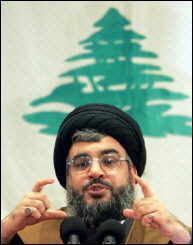
Sderot is not the only Israeli city under rocket threat. According to the latest wire reports, Israel says Hezbollah has rearmed with longer-ranged weapons and now can hit Tel Aviv. Lebanese sources claim that the new rocketry hoard is to deter Israeli aggression, rather than to threaten the Jewish state, but Hassan Nasrullah's speeches belie this.

Israel alleges that Hezbollah militants in Lebanon have rearmed with new long-range rockets capable of hitting Tel Aviv and tripled their arsenal of land-to-sea missiles since last summer's war, the United Nations secretary-general said in a report Wednesday.

Ban Ki-Moon said the reports of Hezbollah's rearming are a cause of great concern for the stability of Lebanon.

"Israel has stated that the nature and number of weapons in Hezbollah's control constitutes a strategic threat to its security and the safety of its citizens," he said.

Israel claims Hezbollah's long-range rocket force is stationed in areas north of the Litani River and that most of the new rockets, including hundreds of Zilzal and Fajr generation rockets, have a range of 155 miles, "enabling them to reach Tel Aviv and points further south," the report said.

"Israel also claims that Hezbollah has tripled its shore-to-sea C-802 missiles and have established an air defense unit armed with ground-to-air missiles," Ban said.

While Israel has not provided the United Nations with specific intelligence due to the sensitivity of the sources, Ban said several speeches by Hezbollah's leader Hassan Nasrallah in the past few months "seem to confirm these Israeli claims."

Senior Hezbollah officials have said Nasrallah's comments were made to serve as a deterrent to aggression rather than as threats to Israel, Ban said.

"Reports of rearming are a cause of great concern which pose serious challenges for the sovereignty, stability and independence of Lebanon," he added.

Ban said Israel's contention that Hezbollah has rearmed to a level higher than before last year's war — and that arms continue to be smuggled across the Lebanon-Syria border despite Syrian denials — raise serious concerns about implementation of the U.N. resolution that ended the 34-day war between Israel and Hezbollah.

Under the Security Council resolution, weapons transfers to the Iranian- and Syrian-backed militants are banned. Ban warned during a visit to Lebanon in March that arms smuggling threatened the Aug. 14, 2006 cease-fire. The resolution calls for the disarming of all militias.

Ban said there has been no progress the disarmament of Hezbollah and other militias, although he sees this as essential to fully restoring government authority throughout the country. The current political crisis in Lebanon has hindered efforts to implement the resolution.


Friday, September 21, 2007

Syrian threat is for the birds


The only thing they are dropping is guano, but the IDF is gunning for them. A flock of migratory birds winging over the Syrian border into Israeli airspace sent fighter jets scrambling on this sensitive frontier, according to wire reports. For the past few days, the Israeli armed forces were on maneuvers near the border and there had been no visible Syrian response to the buildup. The IDF is on heightened security alert as the country celebrates Yom Kippur, the day of atonement, and takes a 24 hour fast.

Israeli fighter pilots scrambled warplanes on Friday after ground radar spotted a potential airborne enemy flying from Syria -- only to discover the culprits were migratory birds, army radio reported.

Israeli radar picked up the birds over the Syrian border but officers were unable to rule them out as enemy aircraft from the screen images.

Tensions have heightened on Israel's northern border with Syria since Damascus said its air defences fired on Israeli warplanes that dropped munitions inside its territory in the early hours of September 6. All reporting on the incident has been censored inside Israel.

A military official quoted by the radio stressed that false alerts are common and precautionary action requires warplanes to head off any possible risk.

Israel and Syria are technically at war and the last round of peace negotiations collapsed in 2000, over the fate of the Golan Heights which Israel captured from Syria in the 1967 Middle East war and annexed in 1981.

Wednesday, September 19, 2007

Israeli strikes, North Korean nukes, and conjecture of selective leaks


Journalists need to heed the con in conjecture and be a bit skeptical about rumours and anonymous leaks, backed up by notable cherry-pickers like John Bolton, the neo-con former US ambassador to the United Nations. The BBC diplomatic correspondent, Jonathan Marcus, examines the fallout after the mysterious Israeli incursion into Syrian airspace two weeks ago. Tel Aviv still maintains its official silence while the regional wardrums are throbbing. Condi Rice arrives at noon.


Nearly two weeks on from Israel's incursion into Syrian airspace, the mystery surrounding the operation shows little sign of disappearing.

Press reports suggest strongly that the Israeli jets destroyed a facility near Syria's border with Turkey.

All sorts of details of the operation have "leaked" out, but still the precise nature of the "target" remains unclear.

By far the strongest theory though suggests a North Korean nuclear connection - a linkage which the North Korean authorities have strenuously denied.

The story put about by largely unnamed US sources and backed up by the former US ambassador to the United Nations, John Bolton, is that North Korea - under international pressure to scale down its own nuclear weapons programme - has recently transferred equipment or technology to Syria.

And it is this equipment - possibly at a fledgling research centre - that the Israelis hit.

'Political agenda'

All sorts of questions remain. Experts on North Korea's nuclear programme are highly sceptical about the alleged technology transfer.

Joseph Cirincione, director for nuclear policy at the Washington-based Center for American Progress, a liberal think-tank, has gone so far as to describe the story as "nonsense".

Selective leaks are being used to play up the Syria-North Korea connection, he writes on the online site of the journal Foreign Policy.

"This appears to be the work of a small group of officials leaking cherry-picked, unvetted 'intelligence' to key reporters in order to promote a pre-existing political agenda. If this sounds like the run-up to the war with Iraq, then it should," he writes.

Gary Samore of the Council on Foreign Relations, another leading North Korea nuclear expert, was less dismissive when I spoke to him, but equally sceptical.

"I know that the Israelis have been worried for some time that the Syrians were eager to get nuclear technology from North Korea," he said.

"The North Koreans are looking to liquidate at least part of their enrichment programme, and perhaps want to offload the centrifuges and so on that they obtained from Pakistan."

So the Syrians might be "dabbling" with enrichment technology, but this would not represent "a near-term threat", Mr Samore says.

"There are North Koreans in Syria in connection with missile technology," he said, but on the nuclear front "we just don't know".

One thing he saw as strange, however, was the possible location of the "target" that the Israelis may have hit.

This seems to have been very close to the border with Turkey - an odd place for a potential nuclear research establishment.

Scepticism needed

Of course much of the controversy - given the fact that the Syrians and the Israelis have said very little (which is instructive in itself) - centres on the nature of the messengers, the shadowy leakers in Washington.

Only one of them, Andrew Semmel, a senior non-proliferation official, has gone on the record, and then there is the involvement of the controversial Mr Bolton.

Critics suggest that at least some of these people have a strong desire to derail the Bush administration's current negotiations with Pyongyang.

For whatever reason, the latest round of the six-party nuclear talks involving the two Koreas has been postponed at the last minute, apparently at the North Koreans' request.

But as Mr Samore pointed out: "Just because John Bolton is using this for political purposes doesn't mean that it is not true."

This episode once again highlights the problems for the media in dealing with this kind of story, problems that were exemplified - one has to admit in retrospect- by the run-up to the invasion of Iraq.

Journalists need copy. But they also have to weigh up what they are told. Official sources cannot simply be discounted.

But on the other hand, a sufficient degree of scepticism needs to be deployed. And just sometimes, that mighty media machine has to admit that it just does not know.


Peripheral players Bolton and Il


(Cross posted from Feral Beast.)

Tuesday, July 03, 2007

All Domestic Cats traced to Middle East


Felines in my Jerusalem neighborhood have chutzpah that I have not encountered elsewhere. Typically, they spurn the great outdoors and the entire Hinom Valley just to use my potted plants as a private catbox. Forget bamboo spikes, aversion spray, chile peppers, and a campaign of stalking them with power squirt guns and tossed flip flops expressly to make them feel unwelcome. Each cat inevitably comes back. Their caterwauling drowns out the peal of churchbells, calls to prayer, and even the blowing of shofars-- or ram's horns--which my Christian Zionists neighbors are so keen on, as are devout Jews. Litters of itty bitty kitties have been emerging from dumpsters everywhere. Now it transpires that these feral cats of Israel are the real deal, clinging to the branches of the original family tree of Felis sylvestris catus .

Scientists say the DNA of all domestic cats can be traced to the first furry Fertile Crescent creatures,the wild Near Eastern Felis sylvestris lybica, who curled up to be stroked by human beings in Israel, Lebanon, Cyprus, Iraq, and Syria. Long before those cat-worshipping Egyptians came on the scene, these felines chose to rub up against people who had the bright idea to raise grain instead of gathering it. This practice had attracted fat field rats, and the cats sought access to happy hunting grounds, so they apparently tamed themselves! Maybe this news should not be so startling. Alongside the word's oldest profession, a cat house would have been indispensable. With such a long pedigree, no wonder cats act so aloof. A BBC science report says:


Progenitors of today's cats split from their wild counterparts more than 100,000 years ago - much earlier than once thought.
At least five female ancestors from the region gave rise to all the domestic cats alive today, scientists believe.

An op-ed piece in the International Herald Tribune ponders how cats who came in from the wild eventually prospered, but any who spurned human contact eventually fell upon hard times. Without wildness, it muses, we have no way of knowing who we are.
Let us prey.

Tuesday, February 13, 2007

Viagra vice quite nice for Nasrallah


Peculiar sources have funded Hizbollah’s war chest, say federal agents in the US, and this reality seems weirder than fiction or bad propaganda . Izzy spotted a piece in today’s International Herald Tribune which casually mentioned that Sheikh Sayyad Hassan Nasrallah’s militants received a cut from sales of phony viagra pills in Canada and America. Odder still, one fellow who pleaded guilty last year to pushing tens of thousands of these blue diamond-shaped pastilles for $10 a pop was a Jewish widower from Miami Beach.

His herbal lookalikes were stamped “Pfizen” instead of the corporate trademark “Pfizer” , and obviously were not scrutinized by older customers with failing eyesight, although the result of a missing ingredient must soon have become apparent. These were placebos, the kind that spammers endlessly advertise in your email.

Theodore Schenk, a 73-year-old widower from Miami Beach who looks after a disabled daughter, had a clean record until arrested for racketeering fake viagra last summer. His lawyer portrayed his client as a hapless dupe “trying to help out an Arabic fellow he was doing legitimate business with." Schenk pleaded guilty last fall. When one of Miami’s snow birds scams alongside an imam at a minor Montreal mosque, amongst others, it reveals that crime makes for strange bedfellows.

A portion of these criminal profits made their way to orphans of suicide bombers in Lebanon, according to a criminal indictment unsealed in a Detroit courtroom, though considerably more was spent on weapons training and ammunition. The formal trial for the gang was scheduled to begin last month. The majority of these 19 suspects lived in Dearborn, an Arab enclave in suburban Detroit. Colin Freeze, of the Globe and Mail newspaper, disclosed that five Canadians also are accused. Profits from fake zig-zag rolling papers and stolen baby formula also contributed to the Hizbollah war chest.

The symbolism of all this might cause some titters. Buying weapons with profits gained on ersatz erection pills would be almost comical, if Katyusha rockets were not so deadly. Iran and Syria may be behind terror sponsorship, but obviously there is stiff competition: big bucks can be had from digging into the deep pockets of America’s erectile dysfunctional and clubbers who want to go all night. Since there is no sign that the Shia militia is flagging in Lebanon, criminals may still be adding to their coffers.

Friday, December 22, 2006

Slapping down the possibility of peace?


Security was the focus for a quartet of Christian clergymen who crossed into Bethlehem to pray at the grotto where they believe Jesus, the Prince of Peace, was born. The Archbishop of Canterbury, appalled
by his grim journey into the West Bank, pointed out how
the new security barrier, which the Israelis say is preventing suicide attacks, is a manifest symbol of what is "deeply wrong in the human heart". It reveals a "fear of the other and the stranger which keeps all of us in one or another kind of prison", he said. "In this so troubled, complex land, justice and security is never something which one person claims at the expense of another or one community at the expense of another," the archbishop, Dr Rowan Williams, added.

The flight of Christians from this celebrated town is a response to heightened violence and isolation--factors which makes it increasingly hard to eke out a living. Christians used to make up more than 85 per cent of Bethlehem's population in 1948; today they comprise only 12 per cent. But Christian proprietors owned most of the town's hotels, restaurants and souvenir shops. As the West Bank's middle classes abandon their family property, what little prosperity there was vanishes.

Without prosperity, there can be little hope for a Palestinian peace.

Considering the chaos between splintering Palestinian factions, mixed with opportunistic neighbor states that encourage and arm them, the future for peace looks dismal.
Amos Oz ponders the preconditions that Prime Minister Ehud Olmert is putting on any negotiations with Syria, in his latest opinion piece that appeared in the Parisian press; meanwhile Marek Halter, in Le Figaro, examine recent blunders which may be stoking future war in the Middle East.
He cites the
prophet Isaiah - who he calls the ultimate proto-activist, armed only with the Word:
"And the fruit of justice shall be peace; and justice will deliver tranquility and security for all." (Isaiah 32:17)