Showing posts with label Hinom Valley. Show all posts

Saturday, October 18, 2008

Sukkot Reverie


The beauty of Jerusalem took my breath away the other evening, on the roundabout near the old train station, when everything converged. We approached the ancient twisted olive tree on a traffic circle (transplanted from some stolen field, one assumes). It was surrounded by blooming meadow grass, and set against the pastel-toned murals of old-time passengers painted on the station wall. Suddenly an Arab boy galloped on a white horse down the pavement. He was smiling with the warm night wind in his hair and looked as if he’d leapt from the painting. Guys in kippas strolled near a trompe d’ oeil sculpture that looked like a freestanding tarp, draped over an invisible car.

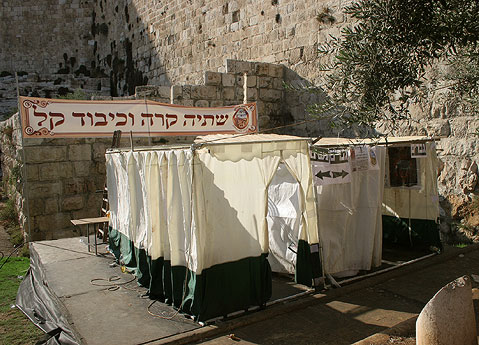
Shadows of palm fronds flicker on the tent-sides all around town. Sukkot looks more intriguing at night. By day, these lean-tos give the city a shabby, shanty look. But inside a sukka, it’s fun and informal, like being in a child’s fort. People come over for tea, hang out, snack, commune together. And the breeze is perfect for flags, so yes, there are parades as pilgrims from across the country and across the world come to the Temple (which isn’t there anymore) and camp in temporary structures to remember God’s bounty while the tribes wandered in the wilderness. Strangely, there seems to be a preponderance of Brazilian evangelicals among the faithful this year, all marching in costume like the World Cup champions in green and bright yellow. The Christian Zionists call Sukkot "the Feast of the Tabernacles," and celebrate in solidarity with Old Testament believers. A trail of African women and South Sea Islanders poured off the stairway near the Pools of Solomon, praised the lord, and picked their way around me down to the Hinom Valley,[Gehenna or Hades.] A couple of Christian End-timers in t-shirts were tooting on ram’s horns. Shofar, so good. (No apocalypse yet). People are smiling.


Locals are have been picnicking everywhere, and the parks' lawns are strewn with litter and look festive, like a party venue the morning after. The weather is delicious, the wind fresh. The moon is lopsided and its light gleams off the pale stones of the Old City in the distance. I can’t quite see the Kotel, the Western Wall, but there’s a steady amount of foot traffic up the road there. The Muslim prayer call sounds, as do the deep throated churchbells from the Basilica of the Assumption.
Wednesday, January 30, 2008

Winograd Snow Job and Israeli Normality

Afternoon dusting over the Old City looks calm before the political dust-up begins in West Jerusalem.


There's a kind of hush that arrives with snowfall. In Jerusalem, the snow already transmogrified to sleet/slush twelve hours into the day and, with special effects from the occasional apocalyptical crack of thunder, it seems other-wordly, not like the muddled east we're accustomed to. From my window, over the Hinom Valley, it appears that Hell (Gahanna) literally may freeze over if this keeps up. It's all blanketed with white.

Talking about a snowball's chance in Hell, there's Olmert and the Winograd report coming up at 5pm. Will he survive? The Prime Minister is braced to be raked over the coals for not producing a victory during the last Lebanon War (or,as the conflict was referred to elsewhere, the "disporoportionate response" that still lost lives and reputations.)
Some would say the country's martial navel-gazing's a tad abnormal.

Well, Israel's abnormality, writes Mary Dejevsky in the London Independent, is changing.

Hermetic security gives the country a fortress-like quality, which is exacerbated by the almost completed barrier along the length of its eastern border. The duration of military service, for both sexes, means that you see many more people in uniform – and armed – than in most advanced countries. There is a gruff and basic efficiency that bespeaks a country still at war. And a pervasive, often irritating, sense of rightness: the past that justifies the present.

In just a couple of years, though, some of the hardest edges seem to have softened. Those young people in uniform look a little more relaxed and less stony-faced about their duty. The ubiquitous weapons are carried just a fraction more casually (which is not necessarily reassuring). There is a greater awareness of demography and neighbourhood, and at state level the response to a crisis is less paranoid. Consider this: when Gazans breached the border into Egypt in their thousands last week, Mr Olmert's response was to meet his Palestinian counterpart. It was not to rush troops to the southern frontier, nor yet to reoccupy Gaza.

Perhaps the Second Lebanon War was not the defeat it appeared. Hezbollah was driven from the border; attacks on Israel ceased. But Israel's two soldiers remained in captivity. And anything less than complete victory was a shock to Israeli confidence. Rather than uniting the country against the enemy, this war sowed division. It also prompted salutary soul-searching about whether tried and tested 20th-century methods would be as effective in the 21st. More self-doubt will greet the Winograd report when it appears.

Tuesday, July 03, 2007

All Domestic Cats traced to Middle East


Felines in my Jerusalem neighborhood have chutzpah that I have not encountered elsewhere. Typically, they spurn the great outdoors and the entire Hinom Valley just to use my potted plants as a private catbox. Forget bamboo spikes, aversion spray, chile peppers, and a campaign of stalking them with power squirt guns and tossed flip flops expressly to make them feel unwelcome. Each cat inevitably comes back. Their caterwauling drowns out the peal of churchbells, calls to prayer, and even the blowing of shofars-- or ram's horns--which my Christian Zionists neighbors are so keen on, as are devout Jews. Litters of itty bitty kitties have been emerging from dumpsters everywhere. Now it transpires that these feral cats of Israel are the real deal, clinging to the branches of the original family tree of Felis sylvestris catus .

Scientists say the DNA of all domestic cats can be traced to the first furry Fertile Crescent creatures,the wild Near Eastern Felis sylvestris lybica, who curled up to be stroked by human beings in Israel, Lebanon, Cyprus, Iraq, and Syria. Long before those cat-worshipping Egyptians came on the scene, these felines chose to rub up against people who had the bright idea to raise grain instead of gathering it. This practice had attracted fat field rats, and the cats sought access to happy hunting grounds, so they apparently tamed themselves! Maybe this news should not be so startling. Alongside the word's oldest profession, a cat house would have been indispensable. With such a long pedigree, no wonder cats act so aloof. A BBC science report says:


Progenitors of today's cats split from their wild counterparts more than 100,000 years ago - much earlier than once thought.
At least five female ancestors from the region gave rise to all the domestic cats alive today, scientists believe.

An op-ed piece in the International Herald Tribune ponders how cats who came in from the wild eventually prospered, but any who spurned human contact eventually fell upon hard times. Without wildness, it muses, we have no way of knowing who we are.
Let us prey.