Palestinian Collaborators
Jamming with South African musicians...an extraordinarily tuneful association. Hat tip to Angela for
this link out of Israel. No more apart-hate anywhere, she advises.
Jamming with South African musicians...an extraordinarily tuneful association. Hat tip to Angela for
this link out of Israel. No more apart-hate anywhere, she advises.

Walid Abu Obeida, a 13-year old farmer’s boy from the West Bank village of Ya’abad, had never spoken to an Israeli until he rounded a corner at dusk carrying his shopping bags and found two Israeli soldiers waiting for him with their guns drawn. “They accused me of throwing stones at them,“ recounts Walid, a skinny kid with dark, hunted eyes. “Then one of them smacked me in face and my nose started bleeding.”
The two soldiers blindfolded and handcuffed Walid, dragged him to a jeep and drove away. All that his family would know about their missing son was that his shoppi ng bags with meat and rice for that evening’s dinner were found in the dusty road. During that interval, the Palestinian boy says he was moved from an army camp to a prison where he was crammed into a cell with five other children, cursed at and humiliated by the guards and beaten by his interrogator until he confessed to stone-throwing.
Walid says he saw his parents “for five about seconds, when the frail, scared boy was brought before an Israeli military court and accused by the uniformed prosecutor not only of throwing stones but of “striking an Israeli officer.” The absurdity of the second charge was apparent to the military judge who only prosecuted Walid for allegedly heaving a stone at soldiers.
Walid got off lightly. He spent 28 days in prison and was fined 500 shekels. Under the Kafkaesque Israeli military law, which reigns in the Palestinian territories, the crime of throwing a stone, at an Israeli solider, or even at the monolithic 20-ft high ”security barrier” enclosing much of the West Bank, can carry a maximum 20 year jail sentence. Every year, an average of 700 Palestinian children are detained, mostly for hurling rocks.
The boy’s case is hardly unusual. A damning report of the Israeli military justice system in the Palestinian territories was recently compiled by the Palestine office of the Geneva-based Defence for Children International (D.C.I.). Th is report, to be released in mid-June, states that “the ill-treatment and torture” of Palestinian child prisoners “appears to be widespread, systematic and institutionalized, suggesting complicity at all levels of the political and military chain of command.” The group’s director, Rifaat Kassis says that the number of child arrests rose sharply in the last six months, possibly because of a crackdown on Palestinian protests in the West Bank, in the aftermath of Israel’s military assault on Gaza.
The D.C.I. report alleges that under Israeli military justice, it is the norm for children to be interrogated by Israeli police and army without either a lawyer or a family member present, and that most of their convictions are due to confessions extracted during interrogation sessions or from “secret evidence”, usually tip-offs from un-named Palestinian informers, a clear violation of the UN Convention against Torture which Israeli ratified in 1991. The children’s rights defenders collected testimony from 33 minors, including one child identified as “Ezzat H.” who describes: “a soldier wearing black sunglasses came into the room where I was held and pointed his rifle at me. The rifle barrel was a few centimeters from my face. I was so terrified that I started to shiver. He made fun of me and said: ‘shivering?’ Tell me where the pistol is before I shoot you.” Ezzat was only 10.
Fifteen-year old Imad T. says he was riding in a car with two friends past a Jewish settlement near Bethlehem when Israeli soldiers allegedly opened fire, wounding all three. The three Palestinian teenagers were then arrested and taken away in a jeep. “They tied us tightly to stretchers and removed bandages from our wounds, which caused the bleeding to resume," he says. "They started beating us…. Whenever we were shouting, the soldiers would slap us on the face and tell us that they did not want to hear our shouts.”
Reaching the army camp, recounts Imad T., “They took us out of the jeep and placed us in the yard. They tore off al our clothes with scissors. We were totally naked, jut like the day we were born. There were more than 40 soldiers there, who started provoking and insulting us. It was very cold.”
Sometimes, Palestinian teenagers throw themselves into the gears of the Israeli security apparatus to flee unhappiness at home. Forced to wed against her will, Jihad Abu Turki, 15, decided that the interior of an Israeli prison was less confining than her marriage. So she and her 14-year old sister Hadeel put kitchen knives in their handbag and approached an Israeli security checkpoint at Hebron’s Tomb of the Patriarchs. The sisters of course were caught. The younger one spent several months in jail and was fined203,000 shekels, while her sister was given a longer sentence because, as Hadeel explains, “She had a bigger knife”. Under interrogation, the teenaged bride confessed to belonging to the Islamic militant group Hamas and plotting to kill Israeli soldiers. But as her mother Asma explains with a sigh, “All she wanted to do was punish herself. She didn’t want to be married, and this was her way out.”
A U.N Committee Against Torture, which met on May 15th in Geneva, expressed its “concern” over Israel’s alleged abuses of Palestinian child prisoners. In its defence, the Israeli government denies any ill treatment of children detainees and insists that all claims are thoroughly investigated. Israel authorities also claim that the number of complaints of alleged abuse has dropped in recent months, but as Khalid Quzman, a defence lawyer at the Israeli military courts says, “We don’t complain any more because it’s a waste of time. “ Over 600 complaints of torture and ill treatment were filed between 2001 and 2008, he says, “and not a single criminal investigation was ever carried out.”
An Israeli human rights group, B’Tselem, recently published testimony from an Israeli commander who claimed that it was standard army practice to “detain, interrogate and use suitable pressure on every person to get one terrorist. Of all the means of pressure that we use, the vast majority are=2 0against persons who are not involved.” After a spell in an Israeli jail, it’s hard for a young Palestinian to stay un-involved. Thirteen-year old Walid who says he never cared much for anything aside from his school friends and family before his incarceration, now bears a radioactive hatred towards Israelis. “The soldiers’ curses and insults, I’ll carry them to my grave,” he says.
(Exclusive guest post from the Red Heifer)

A landmark speech in Cairo
(Click for video clip) Complete written transcript follows. It lasted nearly one hour at the podium.:
I am honored to be in the timeless city of Cairo, and to be hosted by two remarkable institutions. For over a thousand years, Al-Azhar has stood as a beacon of Islamic learning, and for over a century, Cairo University has been a source of Egypt's advancement. Together, you represent the harmony between tradition and progress. I am grateful for your hospitality, and the hospitality of the people of Egypt. I am also proud to carry with me the goodwill of the American people, and a greeting of peace from Muslim communities in my country: assalaamu alaykum.
We meet at a time of tension between the United States and Muslims around the world - tension rooted in historical forces that go beyond any current policy debate. The relationship between Islam and the West includes centuries of co-existence and cooperation, but also conflict and religious wars. More recently, tension has been fed by colonialism that denied rights and opportunities to many Muslims, and a Cold War in which Muslim-majority countries were too often treated as proxies without regard to their own aspirations. Moreover, the sweeping change brought by modernity and globalization led many Muslims to view the West as hostile to the traditions of Islam.
Violent extremists have exploited these tensions in a small but potent minority of Muslims. The attacks of September 11th, 2001 and the continued efforts of these extremists to engage in violence against civilians has led some in my country to view Islam as inevitably hostile not only to America and Western countries, but also to human rights. This has bred more fear and mistrust.
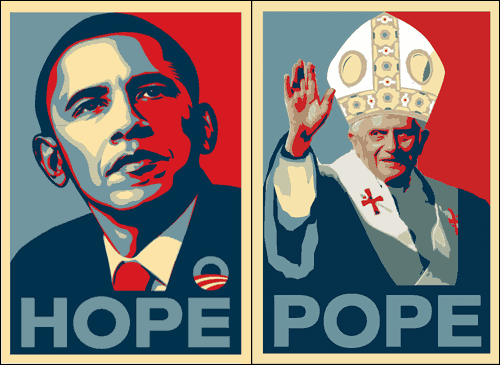
[Barack and B-16. The Prez borrowed his line about a stalemate in Bethelem]
So long as our relationship is defined by our differences, we will empower those who sow hatred rather than peace, and who promote conflict rather than the cooperation that can help all of our people achieve justice and prosperity. This cycle of suspicion and discord must end.
I have come here to seek a new beginning between the United States and Muslims around the world; one based upon mutual interest and mutual respect; and one based upon the truth that America and Islam are not exclusive, and need not be in competition. Instead, they overlap, and share common principles - principles of justice and progress; tolerance and the dignity of all human beings.
I do so recognizing that change cannot happen overnight. No single speech can eradicate years of mistrust, nor can I answer in the time that I have all the complex questions that brought us to this point. But I am convinced that in order to move forward, we must say openly the things we hold in our hearts, and that too often are said only behind closed doors. There must be a sustained effort to listen to each other; to learn from each other; to respect one another; and to seek common ground. As the Holy Koran tells us, "Be conscious of God and speak always the truth." That is what I will try to do - to speak the truth as best I can, humbled by the task before us, and firm in my belief that the interests we share as human beings are far more powerful than the forces that drive us apart.
Part of this conviction is rooted in my own experience. I am a Christian, but my father came from a Kenyan family that includes generations of Muslims. As a boy, I spent several years in Indonesia and heard the call of the azaan at the break of dawn and the fall of dusk. As a young man, I worked in Chicago communities where many found dignity and peace in their Muslim faith.
As a student of history, I also know civilization's debt to Islam. It was Islam - at places like Al-Azhar University - that carried the light of learning through so many centuries, paving the way for Europe's Renaissance and Enlightenment. It was innovation in Muslim communities that developed the order of algebra; our magnetic compass and tools of navigation; our mastery of pens and printing; our understanding of how disease spreads and how it can be healed. Islamic culture has given us majestic arches and soaring spires; timeless poetry and cherished music; elegant calligraphy and places of peaceful contemplation. And throughout history, Islam has demonstrated through words and deeds the possibilities of religious tolerance and racial equality.
I know, too, that Islam has always been a part of America's story. The first nation to recognize my country was Morocco. In signing the Treaty of Tripoli in 1796, our second President John Adams wrote, "The United States has in itself no character of enmity against the laws, religion or tranquility of Muslims." And since our founding, American Muslims have enriched the United States. They have fought in our wars, served in government, stood for civil rights, started businesses, taught at our Universities, excelled in our sports arenas, won Nobel Prizes, built our tallest building, and lit the Olympic Torch. And when the first Muslim-American was recently elected to Congress, he took the oath to defend our Constitution using the same Holy Koran that one of our Founding Fathers - Thomas Jefferson - kept in his personal library.
So I have known Islam on three continents before coming to the region where it was first revealed. That experience guides my conviction that partnership between America and Islam must be based on what Islam is, not what it isn't. And I consider it part of my responsibility as President of the United States to fight against negative stereotypes of Islam wherever they appear.
But that same principle must apply to Muslim perceptions of America. Just as Muslims do not fit a crude stereotype, America is not the crude stereotype of a self-interested empire. The United States has been one of the greatest sources of progress that the world has ever known. We were born out of revolution against an empire. We were founded upon the ideal that all are created equal, and we have shed blood and struggled for centuries to give meaning to those words - within our borders, and around the world. We are shaped by every culture, drawn from every end of the Earth, and dedicated to a simple concept: E pluribus unum: "Out of many, one."
Much has been made of the fact that an African-American with the name Barack Hussein Obama could be elected President. But my personal story is not so unique. The dream of opportunity for all people has not come true for everyone in America, but its promise exists for all who come to our shores - that includes nearly seven million American Muslims in our country today who enjoy incomes and education that are higher than average.
Moreover, freedom in America is indivisible from the freedom to practice one's religion. That is why there is a mosque in every state of our union, and over 1,200 mosques within our borders. That is why the U.S. government has gone to court to protect the right of women and girls to wear the hijab, and to punish those who would deny it.
So let there be no doubt: Islam is a part of America. And I believe that America holds within her the truth that regardless of race, religion, or station in life, all of us share common aspirations - to live in peace and security; to get an education and to work with dignity; to love our families, our communities, and our God. These things we share. This is the hope of all humanity.
Of course, recognizing our common humanity is only the beginning of our task. Words alone cannot meet the needs of our people. These needs will be met only if we act boldly in the years ahead; and if we understand that the challenges we face are shared, and our failure to meet them will hurt us all.
For we have learned from recent experience that when a financial system weakens in one country, prosperity is hurt everywhere. When a new flu infects one human being, all are at risk. When one nation pursues a nuclear weapon, the risk of nuclear attack rises for all nations. When violent extremists operate in one stretch of mountains, people are endangered across an ocean. And when innocents in Bosnia and Darfur are slaughtered, that is a stain on our collective conscience. That is what it means to share this world in the 21st century. That is the responsibility we have to one another as human beings.
This is a difficult responsibility to embrace. For human history has often been a record of nations and tribes subjugating one another to serve their own interests. Yet in this new age, such attitudes are self-defeating. Given our interdependence, any world order that elevates one nation or group of people over another will inevitably fail. So whatever we think of the past, we must not be prisoners of it. Our problems must be dealt with through partnership; progress must be shared.
That does not mean we should ignore sources of tension. Indeed, it suggests the opposite: we must face these tensions squarely. And so in that spirit, let me speak as clearly and plainly as I can about some specific issues that I believe we must finally confront together.
The first issue that we have to confront is violent extremism in all of its forms.
In Ankara, I made clear that America is not - and never will be - at war with Islam. We will, however, relentlessly confront violent extremists who pose a grave threat to our security. Because we reject the same thing that people of all faiths reject: the killing of innocent men, women, and children. And it is my first duty as President to protect the American people.
The situation in Afghanistan demonstrates America's goals, and our need to work together. Over seven years ago, the United States pursued al Qaeda and the Taliban with broad international support. We did not go by choice, we went because of necessity. I am aware that some question or justify the events of 9/11. But let us be clear: al Qaeda killed nearly 3,000 people on that day. The victims were innocent men, women and children from America and many other nations who had done nothing to harm anybody. And yet Al Qaeda chose to ruthlessly murder these people, claimed credit for the attack, and even now states their determination to kill on a massive scale. They have affiliates in many countries and are trying to expand their reach. These are not opinions to be debated; these are facts to be dealt with.
Make no mistake: we do not want to keep our troops in Afghanistan. We seek no military bases there. It is agonizing for America to lose our young men and women. It is costly and politically difficult to continue this conflict. We would gladly bring every single one of our troops home if we could be confident that there were not violent extremists in Afghanistan and Pakistan determined to kill as many Americans as they possibly can. But that is not yet the case.
That's why we're partnering with a coalition of forty-six countries. And despite the costs involved, America's commitment will not weaken. Indeed, none of us should tolerate these extremists. They have killed in many countries. They have killed people of different faiths - more than any other, they have killed Muslims. Their actions are irreconcilable with the rights of human beings, the progress of nations, and with Islam. The Holy Koran teaches that whoever kills an innocent, it is as if he has killed all mankind; and whoever saves a person, it is as if he has saved all mankind. The enduring faith of over a billion people is so much bigger than the narrow hatred of a few. Islam is not part of the problem in combating violent extremism - it is an important part of promoting peace.
We also know that military power alone is not going to solve the problems in Afghanistan and Pakistan. That is why we plan to invest $1.5 billion each year over the next five years to partner with Pakistanis to build schools and hospitals, roads and businesses, and hundreds of millions to help those who have been displaced. And that is why we are providing more than $2.8 billion to help Afghans develop their economy and deliver services that people depend upon.
Let me also address the issue of Iraq. Unlike Afghanistan, Iraq was a war of choice that provoked strong differences in my country and around the world. Although I believe that the Iraqi people are ultimately better off without the tyranny of Saddam Hussein, I also believe that events in Iraq have reminded America of the need to use diplomacy and build international consensus to resolve our problems whenever possible. Indeed, we can recall the words of Thomas Jefferson, who said: "I hope that our wisdom will grow with our power, and teach us that the less we use our power the greater it will be."
Today, America has a dual responsibility: to help Iraq forge a better future - and to leave Iraq to Iraqis. I have made it clear to the Iraqi people that we pursue no bases, and no claim on their territory or resources. Iraq's sovereignty is its own. That is why I ordered the removal of our combat brigades by next August. That is why we will honor our agreement with Iraq's democratically-elected government to remove combat troops from Iraqi cities by July, and to remove all our troops from Iraq by 2012. We will help Iraq train its Security Forces and develop its economy. But we will support a secure and united Iraq as a partner, and never as a patron.
And finally, just as America can never tolerate violence by extremists, we must never alter our principles. 9/11 was an enormous trauma to our country. The fear and anger that it provoked was understandable, but in some cases, it led us to act contrary to our ideals. We are taking concrete actions to change course. I have unequivocally prohibited the use of torture by the United States, and I have ordered the prison at Guantanamo Bay closed by early next year.
So America will defend itself respectful of the sovereignty of nations and the rule of law. And we will do so in partnership with Muslim communities which are also threatened. The sooner the extremists are isolated and unwelcome in Muslim communities, the sooner we will all be safer.
The second major source of tension that we need to discuss is the situation between Israelis, Palestinians and the Arab world.
America's strong bonds with Israel are well known. This bond is unbreakable. It is based upon cultural and historical ties, and the recognition that the aspiration for a Jewish homeland is rooted in a tragic history that cannot be denied.
Around the world, the Jewish people were persecuted for centuries, and anti-Semitism in Europe culminated in an unprecedented Holocaust. Tomorrow, I will visit Buchenwald, which was part of a network of camps where Jews were enslaved, tortured, shot and gassed to death by the Third Reich. Six million Jews were killed - more than the entire Jewish population of Israel today. Denying that fact is baseless, ignorant, and hateful. Threatening Israel with destruction - or repeating vile stereotypes about Jews - is deeply wrong, and only serves to evoke in the minds of Israelis this most painful of memories while preventing the peace that the people of this region deserve.
On the other hand, it is also undeniable that the Palestinian people - Muslims and Christians - have suffered in pursuit of a homeland. For more than sixty years they have endured the pain of dislocation. Many wait in refugee camps in the West Bank, Gaza, and neighboring lands for a life of peace and security that they have never been able to lead. They endure the daily humiliations - large and small - that come with occupation. So let there be no doubt: the situation for the Palestinian people is intolerable. America will not turn our backs on the legitimate Palestinian aspiration for dignity, opportunity, and a state of their own.
For decades, there has been a stalemate: two peoples with legitimate aspirations, each with a painful history that makes compromise elusive. It is easy to point fingers - for Palestinians to point to the displacement brought by Israel's founding, and for Israelis to point to the constant hostility and attacks throughout its history from within its borders as well as beyond. But if we see this conflict only from one side or the other, then we will be blind to the truth: the only resolution is for the aspirations of both sides to be met through two states, where Israelis and Palestinians each live in peace and security.
That is in Israel's interest, Palestine's interest, America's interest, and the world's interest. That is why I intend to personally pursue this outcome with all the patience that the task requires. The obligations that the parties have agreed to under the Road Map are clear. For peace to come, it is time for them - and all of us - to live up to our responsibilities.
Palestinians must abandon violence. Resistance through violence and killing is wrong and does not succeed. For centuries, black people in America suffered the lash of the whip as slaves and the humiliation of segregation. But it was not violence that won full and equal rights. It was a peaceful and determined insistence upon the ideals at the center of America's founding. This same story can be told by people from South Africa to South Asia; from Eastern Europe to Indonesia. It's a story with a simple truth: that violence is a dead end. It is a sign of neither courage nor power to shoot rockets at sleeping children, or to blow up old women on a bus. That is not how moral authority is claimed; that is how it is surrendered.
Now is the time for Palestinians to focus on what they can build. The Palestinian Authority must develop its capacity to govern, with institutions that serve the needs of its people. Hamas does have support among some Palestinians, but they also have responsibilities. To play a role in fulfilling Palestinian aspirations, and to unify the Palestinian people, Hamas must put an end to violence, recognize past agreements, and recognize Israel's right to exist.
At the same time, Israelis must acknowledge that just as Israel's right to exist cannot be denied, neither can Palestine's. The United States does not accept the legitimacy of continued Israeli settlements. This construction violates previous agreements and undermines efforts to achieve peace. It is time for these settlements to stop.
Israel must also live up to its obligations to ensure that Palestinians can live, and work, and develop their society. And just as it devastates Palestinian families, the continuing humanitarian crisis in Gaza does not serve Israel's security; neither does the continuing lack of opportunity in the West Bank. Progress in the daily lives of the Palestinian people must be part of a road to peace, and Israel must take concrete steps to enable such progress.
Finally, the Arab States must recognize that the Arab Peace Initiative was an important beginning, but not the end of their responsibilities. The Arab-Israeli conflict should no longer be used to distract the people of Arab nations from other problems. Instead, it must be a cause for action to help the Palestinian people develop the institutions that will sustain their state; to recognize Israel's legitimacy; and to choose progress over a self-defeating focus on the past.
America will align our policies with those who pursue peace, and say in public what we say in private to Israelis and Palestinians and Arabs. We cannot impose peace. But privately, many Muslims recognize that Israel will not go away. Likewise, many Israelis recognize the need for a Palestinian state. It is time for us to act on what everyone knows to be true.
Too many tears have flowed. Too much blood has been shed. All of us have a responsibility to work for the day when the mothers of Israelis and Palestinians can see their children grow up without fear; when the Holy Land of three great faiths is the place of peace that God intended it to be; when Jerusalem is a secure and lasting home for Jews and Christians and Muslims, and a place for all of the children of Abraham to mingle peacefully together as in the story of Isra, when Moses, Jesus, and Mohammed (peace be upon them) joined in prayer.
The third source of tension is our shared interest in the rights and responsibilities of nations on nuclear weapons.
This issue has been a source of tension between the United States and the Islamic Republic of Iran. For many years, Iran has defined itself in part by its opposition to my country, and there is indeed a tumultuous history between us. In the middle of the Cold War, the United States played a role in the overthrow of a democratically-elected Iranian government. Since the Islamic Revolution, Iran has played a role in acts of hostage-taking and violence against U.S. troops and civilians. This history is well known. Rather than remain trapped in the past, I have made it clear to Iran's leaders and people that my country is prepared to move forward. The question, now, is not what Iran is against, but rather what future it wants to build.
It will be hard to overcome decades of mistrust, but we will proceed with courage, rectitude and resolve. There will be many issues to discuss between our two countries, and we are willing to move forward without preconditions on the basis of mutual respect. But it is clear to all concerned that when it comes to nuclear weapons, we have reached a decisive point. This is not simply about America's interests. It is about preventing a nuclear arms race in the Middle East that could lead this region and the world down a hugely dangerous path.
I understand those who protest that some countries have weapons that others do not. No single nation should pick and choose which nations hold nuclear weapons. That is why I strongly reaffirmed America's commitment to seek a world in which no nations hold nuclear weapons. And any nation - including Iran - should have the right to access peaceful nuclear power if it complies with its responsibilities under the nuclear Non-Proliferation Treaty. That commitment is at the core of the Treaty, and it must be kept for all who fully abide by it. And I am hopeful that all countries in the region can share in this goal.
The fourth issue that I will address is democracy.
I know there has been controversy about the promotion of democracy in recent years, and much of this controversy is connected to the war in Iraq. So let me be clear: no system of government can or should be imposed upon one nation by any other.
That does not lessen my commitment, however, to governments that reflect the will of the people. Each nation gives life to this principle in its own way, grounded in the traditions of its own people. America does not presume to know what is best for everyone, just as we would not presume to pick the outcome of a peaceful election. But I do have an unyielding belief that all people yearn for certain things: the ability to speak your mind and have a say in how you are governed; confidence in the rule of law and the equal administration of justice; government that is transparent and doesn't steal from the people; the freedom to live as you choose. Those are not just American ideas, they are human rights, and that is why we will support them everywhere.
There is no straight line to realize this promise. But this much is clear: governments that protect these rights are ultimately more stable, successful and secure. Suppressing ideas never succeeds in making them go away. America respects the right of all peaceful and law-abiding voices to be heard around the world, even if we disagree with them. And we will welcome all elected, peaceful governments - provided they govern with respect for all their people.
This last point is important because there are some who advocate for democracy only when they are out of power; once in power, they are ruthless in suppressing the rights of others. No matter where it takes hold, government of the people and by the people sets a single standard for all who hold power: you must maintain your power through consent, not coercion; you must respect the rights of minorities, and participate with a spirit of tolerance and compromise; you must place the interests of your people and the legitimate workings of the political process above your party. Without these ingredients, elections alone do not make true democracy.
The fifth issue that we must address together is religious freedom.
Islam has a proud tradition of tolerance. We see it in the history of Andalusia and Cordoba during the Inquisition. I saw it firsthand as a child in Indonesia, where devout Christians worshiped freely in an overwhelmingly Muslim country. That is the spirit we need today. People in every country should be free to choose and live their faith based upon the persuasion of the mind, heart, and soul. This tolerance is essential for religion to thrive, but it is being challenged in many different ways.
Among some Muslims, there is a disturbing tendency to measure one's own faith by the rejection of another's. The richness of religious diversity must be upheld - whether it is for Maronites in Lebanon or the Copts in Egypt. And fault lines must be closed among Muslims as well, as the divisions between Sunni and Shia have led to tragic violence, particularly in Iraq.
Freedom of religion is central to the ability of peoples to live together. We must always examine the ways in which we protect it. For instance, in the United States, rules on charitable giving have made it harder for Muslims to fulfill their religious obligation. That is why I am committed to working with American Muslims to ensure that they can fulfill zakat.
Likewise, it is important for Western countries to avoid impeding Muslim citizens from practicing religion as they see fit - for instance, by dictating what clothes a Muslim woman should wear. We cannot disguise hostility towards any religion behind the pretence of liberalism.
Indeed, faith should bring us together. That is why we are forging service projects in America that bring together Christians, Muslims, and Jews. That is why we welcome efforts like Saudi Arabian King Abdullah's Interfaith dialogue and Turkey's leadership in the Alliance of Civilizations. Around the world, we can turn dialogue into Interfaith service, so bridges between peoples lead to action - whether it is combating malaria in Africa, or providing relief after a natural disaster.
The sixth issue that I want to address is women's rights.
I know there is debate about this issue. I reject the view of some in the West that a woman who chooses to cover her hair is somehow less equal, but I do believe that a woman who is denied an education is denied equality. And it is no coincidence that countries where women are well-educated are far more likely to be prosperous.
Now let me be clear: issues of women's equality are by no means simply an issue for Islam. In Turkey, Pakistan, Bangladesh and Indonesia, we have seen Muslim-majority countries elect a woman to lead. Meanwhile, the struggle for women's equality continues in many aspects of American life, and in countries around the world.
Our daughters can contribute just as much to society as our sons, and our common prosperity will be advanced by allowing all humanity - men and women - to reach their full potential. I do not believe that women must make the same choices as men in order to be equal, and I respect those women who choose to live their lives in traditional roles. But it should be their choice. That is why the United States will partner with any Muslim-majority country to support expanded literacy for girls, and to help young women pursue employment through micro-financing that helps people live their dreams.
Finally, I want to discuss economic development and opportunity.
I know that for many, the face of globalization is contradictory. The Internet and television can bring knowledge and information, but also offensive sexuality and mindless violence. Trade can bring new wealth and opportunities, but also huge disruptions and changing communities. In all nations - including my own - this change can bring fear. Fear that because of modernity we will lose of control over our economic choices, our politics, and most importantly our identities - those things we most cherish about our communities, our families, our traditions, and our faith.
But I also know that human progress cannot be denied. There need not be contradiction between development and tradition. Countries like Japan and South Korea grew their economies while maintaining distinct cultures. The same is true for the astonishing progress within Muslim-majority countries from Kuala Lumpur to Dubai. In ancient times and in our times, Muslim communities have been at the forefront of innovation and education.
This is important because no development strategy can be based only upon what comes out of the ground, nor can it be sustained while young people are out of work. Many Gulf States have enjoyed great wealth as a consequence of oil, and some are beginning to focus it on broader development. But all of us must recognize that education and innovation will be the currency of the 21st century, and in too many Muslim communities there remains underinvestment in these areas. I am emphasizing such investments within my country. And while America in the past has focused on oil and gas in this part of the world, we now seek a broader engagement.
On education, we will expand exchange programs, and increase scholarships, like the one that brought my father to America, while encouraging more Americans to study in Muslim communities. And we will match promising Muslim students with internships in America; invest in on-line learning for teachers and children around the world; and create a new online network, so a teenager in Kansas can communicate instantly with a teenager in Cairo.
On economic development, we will create a new corps of business volunteers to partner with counterparts in Muslim-majority countries. And I will host a Summit on Entrepreneurship this year to identify how we can deepen ties between business leaders, foundations and social entrepreneurs in the United States and Muslim communities around the world.
On science and technology, we will launch a new fund to support technological development in Muslim-majority countries, and to help transfer ideas to the marketplace so they can create jobs. We will open centers of scientific excellence in Africa, the Middle East and Southeast Asia, and appoint new Science Envoys to collaborate on programs that develop new sources of energy, create green jobs, digitize records, clean water, and grow new crops. And today I am announcing a new global effort with the Organization of the Islamic Conference to eradicate polio. And we will also expand partnerships with Muslim communities to promote child and maternal health.
All these things must be done in partnership. Americans are ready to join with citizens and governments; community organizations, religious leaders, and businesses in Muslim communities around the world to help our people pursue a better life.
The issues that I have described will not be easy to address. But we have a responsibility to join together on behalf of the world we seek - a world where extremists no longer threaten our people, and American troops have come home; a world where Israelis and Palestinians are each secure in a state of their own, and nuclear energy is used for peaceful purposes; a world where governments serve their citizens, and the rights of all God's children are respected. Those are mutual interests. That is the world we seek. But we can only achieve it together.
I know there are many - Muslim and non-Muslim - who question whether we can forge this new beginning. Some are eager to stoke the flames of division, and to stand in the way of progress. Some suggest that it isn't worth the effort - that we are fated to disagree, and civilizations are doomed to clash. Many more are simply skeptical that real change can occur. There is so much fear, so much mistrust. But if we choose to be bound by the past, we will never move forward. And I want to particularly say this to young people of every faith, in every country - you, more than anyone, have the ability to remake this world.
All of us share this world for but a brief moment in time. The question is whether we spend that time focused on what pushes us apart, or whether we commit ourselves to an effort - a sustained effort - to find common ground, to focus on the future we seek for our children, and to respect the dignity of all human beings.
It is easier to start wars than to end them. It is easier to blame others than to look inward; to see what is different about someone than to find the things we share. But we should choose the right path, not just the easy path. There is also one rule that lies at the heart of every religion - that we do unto others as we would have them do unto us. This truth transcends nations and peoples - a belief that isn't new; that isn't black or white or brown; that isn't Christian, or Muslim or Jew. It's a belief that pulsed in the cradle of civilization, and that still beats in the heart of billions. It's a faith in other people, and it's what brought me here today.
We have the power to make the world we seek, but only if we have the courage to make a new beginning, keeping in mind what has been written.
The Holy Koran tells us, "O mankind! We have created you male and a female; and we have made you into nations and tribes so that you may know one another."
The Talmud tells us: "The whole of the Torah is for the purpose of promoting peace."
The Holy Bible tells us, "Blessed are the peacemakers, for they shall be called sons of God."
The people of the world can live together in peace. We know that is God's vision. Now, that must be our work here on Earth. Thank you. And may God's peace be upon you.


Road rage on the roadmap to Peace? A Palestinian worker went berserk today in Jerusalem, and killed at least three people and injured dozens more by ramming his bulldozer into a couple of downtown buses and flattening private cars. Ultimately police shot the assailant in the head with an Uzi in order to halt his rampage that had scattered screaming pedestrians. He had taken the bulldozer from a building site for the light railway and headed into the traffic with a vengeance. The man reportedly lives in East Jerusalem and had his work permits in order.Security has tightened across the city, especially near the markets.
Jerusalem's ultra-Orthodox Mayor Uri Lupolianski lamented that terrorists were constantly coming up with new ways to harm Jerusalem. This is the first public attack in nearly four years in the city, although a Jewish seminary was the scene of a serial shooting attack by a Palestinian earlier this year.
"My daughter was in the next bus, but she wasn't hurt," Lupolianski told reporters. "To our regret the attackers do not cease coming up with new ways to strike at the heart of the Jewish people here in Jerusalem."
It appears that the man, Hosam Tayseer Dawyyat, who had a criminal record, was acting alone, not as part of a terrorism plot. Predictably, a Hamas spokesman said Wednesday that the random attack was "a natural reaction to Israel's aggression," adding Hamas did not know who was behind the attack. There have been calls by Ehud Olmert to demolish his living quarters in retribution. And a little-known group in the Galilee claimed credit for the bizarre attack, but this was not corroborated.
The man who killed the bulldozer driver was Moshe Klessner, 18, who is reportedly the brother-in-law of IDF officer David Shapira. Shapira killed the Arab shooter who attacked the Mercaz Harav religious seminary, according to the Jerusalem Post. A 4-month old baby escaped serious injury and was found by police beside a flattened car; its parents have yet to be located.
Several emergency hotlines have been set following the attack:
Shaare Zedek Medical Center can be reached at 1255125.
The Jerusalem Municipality's hotline 972-2-5314600/1/2/3/4.
The Immigrant Absorption Ministry opened another hotline, offering assistance in English, French, Spanish, Russian and Amharic. Contact 1255021010.
Addendum from Agence France Press:
Public Security Minister Avi Dichter told reporters the attack would not succeed in severing mostly Arab east Jerusalem from what Israel considers its "eternal, undivided" capital.
"One must remember that one third of Jerusalem are Arab citizens but all of Jerusalem is Israel's sovereign territory," he said.
"Whoever thinks that the one third of east Jerusalemites will succeed to sever part of Jerusalem and take it out of Israeli control is wrong."
Peace talks resumed between Israel and the Palestinians in November but have stalled amid violence in and around the Gaza Strip and continued Jewish settlement building on occupied Palestinian land.
At least 524 people have been killed since the negotiations resumed, mostly militants in the besieged Gaza Strip, according to an AFP count.
An unlikely line of hope links Palestinians and Israelis, Jeremy Grange reports for the BBC. Most Israelis have never met a Palestinian and most Palestinians have never met an Israeli - apart, that is, from soldiers and settlers. Yet some, who have lost what's most important, are speaking to one another.
A unique phone service linking Israelis and Palestinians, called Hello Peace, has made nearly a million telephone conversations possible since it began operating in November 2000.
As we sit talking in his office in a Jerusalem apartment block, graphic designer Rami Elhanan pauses for a moment, deep in thought, recalling the day his life changed forever.
On 4 September 1997, just after three o'clock in the afternoon, a suicide bomber detonated a device in the busy Ben Yehuda Street in central Jerusalem.
Among those killed by the explosion was Rami's 14-year-old daughter, Smadar, who was in town with two friends to buy textbooks for the new school term.
"You never think that the finger is going to point at you," Rami shrugs, remembering the moment his worst fears were realised.
Many parents in the same circumstances would have retreated into the entrenched positions of hatred and the desire for revenge which have characterised Israeli-Palestinian relations for decades.
But Rami is different. About a year after the tragedy he joined the Parents' Circle, a 500-strong organisation which brings together bereaved families from both sides to create dialogue, understanding, even friendships between Palestinians and Israelis.
Ali Abu Awad, from the West Bank town of Beit Ummar near Hebron, is a member of the Parents' Circle. His brother Yousef was killed by an Israeli soldier.
"You just have this question. Why? Is killing my brother securing Israel? What shall I do with this?" Ali says.
"At that moment you have the feeling that you want revenge. But revenge on whom? How many people shall I kill? For me Yousef is worth the whole Israeli people. Even if I kill them all I will not feel better, I mean he will not come back."
One day Ali was contacted by Ishaq Frankental, a member of the Parents' Circle. Ishaq lost his son, who was kidnapped and killed by Hamas. Ali's immediate family ended up joining the Parents' Circle.
"It's so hard, we are not angels. I am a normal person and I have so many hardships every day at the checkpoints and even in talking to people," he says.
"But the difference is that before joining the Parents' Circle I was carrying my brother's story, my personal pain, my nationality as a Palestinian... but today I feel like I am carrying both nations on my back. This is what I want politicians to feel, to feel responsible for the two people who are human beings."
At the Parents' Circle office near Tel Aviv another member reminds me of a few of the harsh truths of the situation.
"Most Israelis have never met a Palestinian and most Palestinians have never met an Israeli - apart, that is, from soldiers and settlers," Robi Damelin says.
That barrier to communication - which has now been given physical reality in the form of the West Bank barrier - is the reason why the Parents' Circle set up Hello Peace, a phone line which allows any Israeli or Palestinian to pick up the phone and speak directly to somebody from the other side.
This initiative, which has now been running for five years and is funded by the European Union, began with a wrong number.
In 2000, in the early days of the second intifada, a young Israeli woman called Natalia Wieseltier dialled a Jewish friend in Tel Aviv but found herself talking to a Palestinian living in the Gaza Strip.
Instead of hanging up she started a conversation.
"He told me his name was Jihad and that things were not going well. He told me that food is rotting at the checkpoints and that his wife was expecting a baby any day and he had no way of getting to the hospital," she says.
Jihad was surprised to find an Israeli being so open and understanding and Natalia was soon receiving regular calls not only from Jihad but from his friends and family too.
She in turn put them in touch with her friends and soon a network of contacts had developed.
When Natalia approached the Parents' Circle with the idea of turning this into a national phone line linking Israelis and Palestinians they embraced the idea.
Since its inception Hello Peace has logged over a million calls.
They may begin as screaming matches between the two sides but many calls have led to lasting friendships.
One Israeli family, for example, regularly met their Palestinian counterparts at a checkpoint to hand over insulin, a medicine that's hard to come by in the Palestinian territories, for their diabetic son.
Back in Jerusalem, Rami ponders the success of Hello Peace and the millions of minutes of dialogue it has generated.
"Just imagine what would happen if the leaders of these crazy nations of ours spoke with each other for even one minute!" he observes.
Izzy Bee is abroad for two weeks, but will attempt to keep a pulse monitor on Israel for loyal readers of this blog. Here's a post, by Anne Penketh of the London Independent, which details how the watchers can watch from afar. The "separation barrier", known as the "security fence" or "the wall", depending on your point of view, is supplemented by remote IDF eyes in the sky. Children under scrutiny view this pale albino guppy that hovers overhead with alarm. Here's how it functions, from an eye-witness:
The Israeli nerve centre watching Gaza's every move
A group of Israeli soldiers is gathered round a television screen. They are watching the grainy images of a youth crawling towards the perimeter fence that hems the Palestinians inside the Gaza Strip.
The dark form tracked on camera is placing a bomb by the fence. Minutes later, his body is shaken by tank fire. A second shot confirms that the militant is dead, and his bomb activated.
We are inside the Nahal Oz military base on the border with Gaza. With the help of a white blimp bristling with cameras, and remote-controlled drones that buzz overhead, the Israeli military have every square inch of Gaza under surveillance.
At Nahal Oz, the headquarters of the southern command which monitors Beit Hanoun and the rest of northern Gaza, the cameras watching the nearby fence pick up every sound.
Palestinians have been warned that if they approach within 300 yards of the fence they are risking their lives. The sensors along the fence can tell the difference between a human and an animal if it ventures into the no-man's land where Palestinian crops and orchards have been flattened. A low throbbing alarm goes off if the sensors are activated.
The moment a Qassam rocket is fired towards Israel, a siren sounds inside the army base. The soldiers know they have 12 seconds before the notoriously inaccurate missile reaches its target, usually in the town of Sderot.
"If a Qassam is fired, we don't fire back straight away because of the possibility of hitting civilians," says a second lieutenant who identifies herself as Hila. "It goes through a lot of levels before we have permission to fire."
On a quiet day, some seven or eight rockets come over the fence. But when tensions are running high, as during the Lebanon war, up to 70 missiles are fired against the Israelis. "They know where we can fire, and where not, so they deliberately choose places where we cannot retaliate," the officer says. In one case, Palestinians fleeing Israeli fire took refuge in a petrol station.
On the army base TV screens militants can be seen using children to place their home-made bombs in an attempt to avoid reprisal gunfire. The fighters are also accused of storing weapons on the first floors of houses, where civilians living in downstairs rooms risk bearing the brunt of Israeli missile strikes.
For a way out of their impasse, some Palestinians now look to Jordan, according to the International Herald Tribune. It's not the kind of two-state solution that once was envisioned.
Inside a drab cellphone shop, in the sprawling Baqaa refugee camp on the outskirts of Amman, Muhammad Khalil and his friends were as gloomy as the fluorescent lights that flickered on the ceiling."Everything has been ruined for us - we've been fighting for 60 years and nothing is left," Khalil said, speaking of the Palestinian cause. Just weeks earlier, he might have been speaking enthusiastically to his friends here, in their usual hangout, about resistance, of fighting for his rights as a Palestinian and of one day returning to a Palestinian state. Last Wednesday, however, he spoke of what he saw as a less satisfying goal for the Palestinians here, and one that raises concerns for many other Jordanians: Palestinian union with Jordan. "It would be better if Jordan ran things in Palestine, if King Abdullah could take control of the West Bank," Khalil said, as his friends nodded. "The issue would be over if Jordan just took control."
Adham Mustafa's bullet-riddled and mutilated body, filmed in a morgue two days after he was taken alive by Hamas, belied the Islamic militant group's promises not to harm its Fatah rivals. So did Tarek Asfour's legs, punctured with marks from nails Hamas gunmen banged into him. Hamas declared a general amnesty for members of the vanquished Fatah movement of moderate President Mahmoud Abbas after sweeping to power in the Gaza Strip on June 15, following a week of fighting. But since then, at least nine Fatah loyalists have been killed, according to Mezan, an independent Gaza-based human rights group, which posted the names of the dead on its website.
The current Rothko exhibit in Tel Aviv's Museum of Art hit me hard in the gut. The press notices should have prepared me for the impact of intense colour and stripped-down form of his paintings, so familiar from art history textbooks and reproduction posters. But in person, they seemed almost overpowering.
This show traced the evolution of Mark Rothko's work, including some early figurative paintings like the demon goddess of the night, Lilith, shown below.
(Another artful and powerful Queen of the Night came calling in the flesh in the Occupied Territories. She appeared in the Magic Flute, one of the pieces performed by the touring Choir of London for a Palestine Mozart Festival which lasted two weeks. Enraptured Palestinian kids from refugee camps would clamber on stage to join the cast for an intimate curtain call. The moment seemed enchanted. Sadly, four of the participating Palestinian musicians missed the final performance in East Jerusalem because their permits were denied and Israeli guards would not let them cross the checkpoint. But I digress).
It was the purely abstract works of Rothko that took my breath away in Tel Aviv. Fuzzy edges of vibrant solid hues mark off entities that enhance one another, never quite touching. Somehow it evoked a coexistence which is vibrant and distinct. If only the lifestyle equivalent could be pulled off in this part of the world,life imitating art would really be something to sing about.
As I left the exhibit, a saw a guard wrest away the mobile phone from a museum-goer who had been surreptitiously snapping all the Rothko paintings. He deleted the tiny images one by one as the photographer scowled, then sulked. It was like a performance artist playing a bully.

Newlywed Najwa Hashash, just 19, despaired of married life with her increasingly feeble bridegroom. The honeymoon was definitely over, because the teenager was required to do the chores of a nurse and orderly along with the housework in cramped quarters. She was desperate to find a way out. Her husband, much older, had little chance of recovering from his debilitating illness according to this article in Ynet. Najwa was arrested yesterday by IDF paratroopers, after rumours circulated during the past three weeks that she planned to strap on an explosive belt and cross the closest checkpoint. Earlier, she'd been detained by the Palestinian Authority and released after questioning. Apparently, they deemed Ms Hashash incapable of anything so hush-hush.
In fact, Najwa's neighbours inside the Balata refugee camp in Nablus suggested that the bride had the blues and spread this malicious gossip herself, hoping to be arrested and jailed as a potential suicide bomber. It was just an escape gambit which would leave her "honor" intact and spare her being murdered if she managed to run away from a bad marriage. But others reckon that a recruiter for the al-Aqsa Martyrs' Brigades took advantage of her misery and persuaded Najwa that if she planned to end her life, she might as well take out some Israelis with her. Why not be glorified as a martyr and get a stipend for her family? (Unsurprisingly, the al-Aqsa Brigades deny any contact with her.)
The Israeli army raided West Bank houses at dawn Tuesday and hauled Najwa in along with two dozen other terror suspects in an ironic twist to Palestine's annual Prisoner Day. They'd released 500 inmates in a good will gesture the previous afternoon, although at least 7600 more-- including 362 children and 82 women-- still are in lockup inside Israel. About ten per cent are held in protective custody indefinitely, without charges against them.
The IDF is not expected to be lenient with Najwa, and there is little hope that she'll be tried quickly. They say Palestinian women are increasingly taking an active part in the conflict, including kidnaps and stabbings. Motives don't really matter. Two of five suicide bombers last year were female, and one was a grandmother. IDF and Shin Bet forces recently arrested 19 Palestinian women suspected of terror activities against Israel. Ten of these women were allegedly affiliated with Fatah and the remainder with Islamic Jihad. Violent female militants are not the only threat. Women tend to serve as messengers, and frequently carry cash for militant groups. So did Najwa accomplish her plan by getting arrested? Did the IDF thwart a deadly attack or enable an adolescent scheme to replace the lonely prison of marriage with actual jail time? Was this girl ever an actual threat?
('Suicide Barbie' blonde bombshell poster is by the conceptual artist Simon Tyszk.)
Border guards at the usually-closed Rafah crossing from Egypt into Gaza shrieked in fear last Thursday after an oddly chubby veiled woman was taken aside for a closer inspection. Beneath her loose robe she had strapped a girdle of live crocodiles! The policewoman screamed and bolted from the search cubicle. Even her seen-it-all superiors succumbed to pat-down panic when the dangerous materials in question had teeth and claws.
 According to press reports, this was no suicide bomber, then, but a wildlife smuggler. She had tied the mouths of three crocodiles shut with string and cinched the trussed reptiles around her waist. (Photo courtesy of Rafah's European observers.) Each was about 20 inches long, and could be sold for around $500, equivalent to a couple months' salary.
The clandestine crocodile girdle was not the first wildlife contraband seized at this sensitive frontier, where arms and drugs are far more common. Another lady once tried to sneak through a monkey tied to her chest, and attempts to smuggle exotic birds and a tiger cub into Gaza have been thwarted. Wearing full hijab, this smuggler was arrested and her reptiles returned to Egyptian custody. The policewomen finally stopped squealing and some even admired the gumption it took to strap on a reptile belt.
Checkpoints are a daily delay for Palestinians who must cross between walled-off areas in the West Bank at a pace determined by bored teenaged security troops with guns.
Now a 22 year old Palestinian woman has come up with some small comfort for foot-sore pedestrians who cannot predict how many hours they must spend standing in line.
Maram Abdel Latif, who works at a rest home for the elderly, spent three years perfecting her cushy gel socks, which seem quite similar to the comfy gel liners of some ski boots. They are especially useful for pregnant women with swollen feet or the aged. 
Although a wearer must have oversized shoes to accommodate Latif's new prototype "watersocks"--possibly even the clownish-looking Crocs, pictured left, which are sported by many trendy Israelis--
she told the BBC that wearing them will make feet feel "like sleeping on a waterbed, which is far more comfortable than a regular mattress".
Once Ms Latif finds a manufacturer to produce these in bulk, Israeli defence forces better be briefed on the new fashion. Otherwise they are apt to mistake her customers for semtex shoe-bombers.
Here’s a dismaying tale about Jerusalem newlyweds who get wrenched apart by social separation barriers just as daunting as the Israeli security fence. Love cannot always find a way around conflict when hatred festers on home ground. BBC news ran a poignant feature clip this week about the challenges when a Jew marries a Muslim in Israel today.
Osama --not a hassle-free name for any Muslim Romeo who must regularly cross a West Bank checkpoint-- discovers that love is not enough to smoothe the way for a secure future with his Jewish bride, Jasmine. Three years into their convention-defying marriage, this besotted couple in their mid-20s cannot find any way to live together without menace. So ultimately Jasmine packs up for exile in Europe, where she hopes her man can join her once he gets permission to travel. Her permit to reside in the West Bank can't be renewed and on Jasmine's Israeli passport, an official stamp says her marital status is "under investigation". So Osama cannot even see his wife off at the airport: the authorities won't recognizes their inter-faith union. The dejected husband is held back by armed guards at the security barrier.
Let's hope the British artist Banksy's vision of breaking through such walls can somehow, someday be made reality. See one of his poignant murals below.
(photo of a bridal couple courtesy of freedigitalphotos.net)
 Well, the Israeli cops tell quite a different tale from the initial Palestinian reports, which should be examined carefully for disinformation. This young Gazan guy, who reportedly was jobless and unable to save his dead baby girl with timely medical help, also lost a good buddy in an Israeli military operation last year. Friends recalled he was depressed, desperate and dangerous. Israeli military intelligence says he travelled through via Egypt, picked up his explosive vest from Islamic urban guerrillas there, crossed the Sinai desert, and hitched a ride into Eilat. An IDF reservist Lt Col who picked him up was immediately suspicious because the glum Arab in a windbreaker did not speak much and looked jumpy. The driver called the cops after he let this hitchhiker off a km out of town, but by then the bomber already had entered the bakery and triggered the blast.
Now security advisers and fence manufacturers may argue that this latest atrocity is reason for a separation barrier to be erected across the Sinai Desert , too. The fence is why attackers from the West Bank have been deterred for 9 months, they say. We shall see.
Dive spots and resorts have been increasingly in the bombers' cross hairs. : Bali (twice), Sharm el Sheik and Dahab in Egypt, Hikkaduwa in Sri Lanka, Antalya in Turkey, Pattani and Narathiwat provinces in southern Thailand. So, best to be careful out there.
(Regional Map by ecanada.com)

Friends invited us this weekend to a unique bar mitzvah ceremony for their son, who is the best known unicyclist in an Israeli-Palestinian children's circus. His classmates -- Arab Christians, Muslims and Jews alike -- joined in his unusually inclusive coming-of-age ritual at a Reform synagogue in West Jerusalem. This did not require as delicate a balancing act as you might assume. Their teacher had prepped the class by assigning readings in a copy of the Old Testament that had been translated into Arabic for them, to get ready for a teen party and a transcultural lesson in co-existence. The disarmingly accuracy of these kids pelting their 13-year-old friend with Hershey's chocolate kisses inside a synagogue could have evoked images of stone-throwing from the first intifada. But there were smiles all around.
The freewheeling shul was welcoming and enthusiastic to the motley crowd. An eloquent woman rabbi read some verses, and at one point, a lesbian activist and family friend carried the Torah scrolls. One of the cantors was a young man with Downs' syndrome who performed flawlessly. An unusual priestly blessing, right before the festive Kiddush, was given by a trio of clerics: a Christian sister spoke in English, a Muslim Imam followed in Arabic, and a Rabbi from Brooklyn summed up everything in atrociously-accented Hebrew. Not your run of the mill Jerusalem bar mitzvah, folks.
(Rehearsal photograph courtesy of shlomophoto.)
 Let there be no barrier to your Christmas joy. We hope that 2007 brings prosperity and peace...or at least a little good will
Seasons Greetings, one and all
(...and a nod to my favourite social researcher for sharing this postmodern image. Graphics are by Banksy, the radical Shoreditch UK graffiti artist, "vandalised oil painting 031"
A daytrip to what amounts to a Jerusalem suburb felt a bit like a mugging. First, the pimply security minders refused entry to our car and insisted that it was against the rules to take a rented vehicle beyond "the fence". "The rule of law will be enforced on my watch," insisted a youngster, caressing his rifle and refusing to look us in the eye. But he couldn't cite the regulation number (and , in fact, journalists technically are allowed to take rental cars inside.) He also refused to talk to any higher-ups on my phone, as it could be a risky ruse to blow him up, and he declined a suggestion to ring them up himself. We went across on foot. Sigh.
The bored Israeli visa stamper kept gabbing to her boyfriend on her cell phone, and we walked through a series of gates and x-rays until we got to the taxi stand on Palestinian turf.
Here, the pace quickened. In the week before Christmas, traditionally high season in Bethlehem, the streets are echoingly empty. We were swarmed--and felt like hapless pigeons about to be plucked. Vendors and taxi drivers were cutting deals over imagined profiteering, and we turned out to be a bitter disappointment for not digging as deeply into our pockets as they had hoped. A Fatah cab driver and an armed Hamas trinket-seller quarreled over us.
Santa Claus, strung up on a pole near the police station, looked rather like he was on the gallows.
Even inside the Church of the Nativity, the atmosphere felt tense. Impatient priests strongarmed visitors out of their way. Chanting and incense swining took precedence over gawkers. Thankfully, the line of Palestinians on the way out were courteous and extremely patient. They go through this twice a day, after all.
 Wondering what those body scans reveal to Israeli border guards at the northern Gaza checkpoint at Erez? The naked truth about whatever you might be packing.
Once you make it through the Mad Max tunnels and place your feet inside the futuristic "backscatter" tube, you invariably are asked to take off your jacket and raise your hands high. The young border guards often reverse the conveyor belt and send your laptop crashing to the cement floor, but eventually a disembodied Israeli voice will instruct you to wait while a short blast of ultrahigh frequency radio waves tickle your front and back. They penetrate most clothing, but won't go through skin to reveal bone like x-rays do. The idea is to bounce off any illicit items or weapons a border-crosser might be trying to smuggle in.
It's quite revealing, so wear your best undies and be prepared for weird looks if you happen to have peculiarly placed piercings. Palestinians consider this type of scan intrusive and intimidating, particularly for pregnant women crossing into Israel for prenatal care. Many people object if these rather intimate scans are not immediately destroyed. Very few Palestinians use this Erez checkpoint anymore, so pressure for decorum has decreased. The press or humanitarian aid workers don't squawk about this humiliation much.
Following Israeli success with this backscatter scanning system, Heathrow airport and some British prisons are experimenting with it, and now Arizona state will follow suit at Phoenix's Sky Harbour International Airport.





 Posts
All Comments
Posts
All Comments