Showing posts with label suicide bomber. Show all posts

Monday, February 04, 2008

Dimona suicide bombers - from West Bank or Gaza?


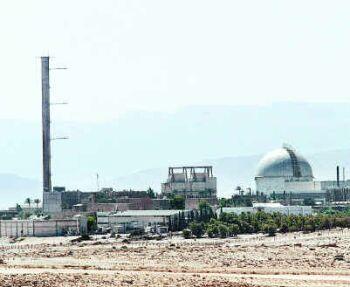
The A-plant in Dimona (above) is secure.
A suicide bomber on Monday morning blew himself up in the southern town that houses Israel's secretive nuclear reactor, killing an Israeli woman and wounding seven other people, Israeli authorities said. Police said they killed a second attacker before he had a chance to detonate his explosives belt. Both of the perpetrators were killed and there was no damage to the reactor, which was miles from the blast.
It was the first suicide attack in Israel in a year, and officials were investigating whether the attackers came in through Egypt after Palestinian militants breached the Gaza-Egypt border last month, according to the Associated Press.

An offshoot of moderate Palestinian President Mahmoud Abbas' Fatah movement claimed responsibility, complicating recently renewed peace efforts. The attackers, they said, came from the West Bank, though the claim could not immediately be verified.
Hours after the suicide bombing, Israeli aircraft struck a car in the northern Gaza Strip, killing a top wanted man.
Israeli government officials dismissed the notion that the heavily guarded Dimona nuclear reactor was the suicide attackers' target. The explosion took place in a shopping area about 10 kilometers (6 miles) from the reactor site.
«We heard a large explosion and people started to run. I saw pieces of flesh flying in the air,» a witness identified only by her first name, Revital, told Army Radio.
Ambulances and a large contingent of soldiers, rescue workers and police rushed to the scene of the bombing, the first in the working class town of 37,000.
Police said one attacker managed to detonate his explosives belt, but the second was shot dead by police before he could set off his bomb. A police bomb squad was on the scene defusing the explosives.
Dr. Baruch Mandelzweig said he was at his clinic nearby when he heard the blast. He and his nurses rushed out to the street to see what had happened, and saw body parts «strewn around everywhere.
They spotted a critically injured man whose head was moving, and began to treat him before realizing he was the second attacker.
«We saw an explosive belt,» he said. «We ran away,» and later we heard he had been shot, Mandelzweig said.
Israeli Foreign Ministry spokesman Arye Mekel said, «the terror organizations have shown again who they are and what they are.
«Their goal was and continues to be to kill Israeli citizens in their homes and their schools and in their shopping centers,» he added. «Israel will continue to fight against this murderous terror.
Shortly after the attack, Israeli aircraft killed a senior commander in the Hamas-affiliated Popular Resistance Committees in the Gaza Strip, the group said. The military confirmed an attack against a PRC activist in Beit Lahiya, a town Palestinian militants frequently use to fire rockets into southern Israel.
At Sunday's Cabinet meeting, Israeli security chiefs warned that because of the anarchy on the Gaza-Egypt frontier, Palestinian militants might enter Israel through Gaza's Sinai desert to attack a civilian Israeli target, a government official said. He spoke on condition of anonymity because the Cabinet meeting was closed.
Southern Israel has been on alert against militant attacks since the Gaza Strip's Islamic Hamas rulers breached the border with Egypt on Jan. 23. Egypt managed to reseal the border only on Sunday.
The breach made Israel's Negev desert, where Dimona is located, more vulnerable to penetration by Palestinian militants who could enter through Egypt's porous border. Dimona is about 60 kilometers (40 miles) northeast of Egypt.
In an e-mail to The Associated Press, the Al Aqsa Martyrs' Brigade, a Fatah offshoot, said it sent attackers from the West Bank town of Ramallah, Abbas' base, to carry out the «heroic martyrdom bombing in Dimona.
The faction said it carried out the attack with the small Popular Front for the Liberation of Palestine.
Although Abbas' government has claimed to have dismantled Al Aqsa forces in the West Bank, a group spokesman, Abu Fouad, said Monday that «nobody has given up weapons.
The bombing came at a critical juncture. Israeli and Palestinian negotiators relaunched peace talks after a seven-year break just two months ago, and Israel has made it clear it won't implement any accord until militant groups in the West Bank and Hamas-ruled Gaza are disarmed.

Abbas' office denounced the attack. But it denied Al Aqsa was involved and linked the bombing to an Israeli raid in the West Bank that killed two Islamic Jihad militants before dawn Monday.
«The Palestinian Authority expresses its full condemnation of the Israeli operation in the northern West Bank and it condemns the attack in the commercial center in the city of Dimona, which targeted Israeli civilians,» his office said.
«Fatah has confirmed that the Al Aqsa Brigades has nothing to do with this attack,» it added, saying that a «well known group opposed to the peace process» was responsible. It did not elaborate.
In the southern Gaza town of Rafah, gunmen fired their weapons into the air to celebrate the bombing.
Hamas spokesman Ayman Taha said he did not know whether his group was involved, but praised the attack. He also rejected suggestions that the bombing would hurt Hamas' chances of reopening the border with Egypt.
«The suicide bombings were there before the closures and the resistance used every opportunity to make these glorious acts,» he said. «They show the Palestinians can respond to the enemy and their crimes.
The previous suicide bombing in Israel occurred on Jan. 29, 2007, when a Palestinian attacker entered Israel from Egypt, killing three Israelis at a bakery in the southern Israeli city of Eilat.
After Israeli-Palestinian peace talks broke down in 2000, Palestinian militants killed hundreds of people in dozens of suicide bombings.
Dimona is home to Israel's nuclear research center, and it is widely believed that atomic weapons were developed at the plant. Israel neither admits nor denies having nuclear arms.


There were only two such attacks between April 2006 and now, the last being in January 2007 when a bomber blew himself up in a bakery in Eilat, killing three people.

The Dimona suicide bomb attack is also the first since renewed efforts to come to an Israeli-Palestinian peace deal were launched with US support late in November.

Israel argues that its blockade of about four million Palestinians in Gaza and large parts of the occupied West Bank prevents such attacks. Intelligence officers suspect that the breach of the Rafah border between the Gaza strip and Egpt, which was resealed only yesterday after a dozen days without regulation, is likely to have played a role in this incident.

Monday, October 01, 2007

'Shabat Shalom, Maradona'-when a suicide bomber switches off


This 100-minute movie, set in Tel Aviv, packs quite a punch and defies cinematic cliches about good guys and bad guys.
Israeli director Dror Zahavi's latest film looks at the Arab-Israeli relationship through the story of a Palestinian terrorist who is issued faulty equipment and suffers the consequences. Donald Macintyre reports in The Independent:


The Israeli director Dror Zahavi succinctly describes the plot of his latest film Shabat Shalom Maradona (Sabbath greetings Maradona): "It's the story of the 48 hours spent in Israel by a suicide bomber who gets stuck in Tel Aviv and doesn't know what to do until the switch of his bomb has been repaired."

Arresting – and accurate – as Mr Zahavi's summary is, it hardly does justice to the complex emotional, psychological and, albeit indirectly, political layers of what is certain to be the one of the most unusual and daring feature films due to screen next year.

Tarek, 20, a Palestinian from the West Bank city of Tulkarem with a promising career as a professional footballer at Maccabee Nazareth, has been chosen to carry out a suicide bombing in the crowded, open-air Carmel Market in Tel Aviv. The title is a nod to the protagonist's passion for football.

He's an eligible candidate for the bombing because his father, by persuading the troops to keep allowing his son through the checkpoint to get to the club, has soon become obliged to do favours for the Israeli military in return; to become, in other words, a small-time collaborator. Now, with the intifada under way and the borders sealed, Tarek's footballing days are over and his father all but ostracised by his own community. To clear his family's name as well as help the Palestinian cause, Tarek agrees to do the bombing. But the explosive belt he wears fails to detonate because the switch has a fault and burns out.

He finds an electrician, Katz, a 70-year-old Auschwitz survivor, to fix the switch – in total ignorance, of course, of its true purpose. But Katz warns Tarek that he won't be able to do the repairs until Sunday morning, because of the Sabbath, and invites him to stay over in his flat until then.

Slowly Tarek discovers something of Jewish life on the other side of the separation barrier that usually serves to make Tulkarem and Tel Aviv, only 25 miles apart, as alien and separate as if they were on different planets. Katz's wife rarely gets out of bed any more; their beloved son died during army manoeuvres while doing his national service many years ago. Finally, on this strange weekend when according to the plan, he should have been already dead, Tarek meets Keren, a 17-year-old Jewish girl who has broken out from her ultra-Orthodox family to live a secular life – and has been beaten by religious members of the community for doing so. The young couple begin a friendship which, with time, might blossom into something more. And he learns a little of the deep-seated Israeli fears of suicide attacks like the one he has crossed the green line to perpetrate.

It wouldn't be fair to future audiences to reveal the ending. It's hardly a happy one, though as Mr Zahavi explains: "This is the story of a suicide bomber who comes with hate and leaves without it." And at least two dramatic yet plausible twists of plot underline the challenges this Israeli-German co-production poses to the received wisdom of many cinemagoers, especially in Israel itself.

Mr Zahavi says that at the wrap party when shooting ended in May he put together – as he usually does to say thank-you to the crew for their hard work – around 15 minutes of rushes from the film for them to watch.

"I guess there were about 60 to 70 people there, mostly people who worked on the film and a few special guests. When the showing finished, there was complete silence. For about five or six minutes nobody was able to say anything. Then they started talking among themselves at first and then people started to come up to me saying: 'I was emotionally impressed. I was so moved by the film. But I didn't want to be moved because it was about a suicide bomber.'"

Mr Zahavi, an experienced 47-year-old Israeli director who has worked – mainly in television – in Germany up to now and for whom this is his first feature in Israel, says this contradiction is bound to manifest itself within sections of the public. For by depicting the bomber as a human being rather than a monster, with palpably human as well as nationalist motives, the film is an "emotional trip" which asks the audience to feel empathy for someone they would normally reject and hate.

Saying that he and the film's veteran Israeli producer, Zvi Spielman, were well aware of the risk they were taking with such a subject, he recognises that not everyone will have the open-mindedness to take easily to the film. "You are breaking a taboo not just politically but emotionally. Some will reject this and some will love it."

But it's clear that Mr Zahavi and Mr Spielman were determined to make a film that in the director's words, would "build a bridge" between Israelis and Palestinians and offer a hope of reconciliation. The dialogue will be in both Hebrew and Arabic. Tarek, the film's leading man, is played by Shredi Jabanin, a young Israeli-Arab actor, who admitted earlier this year that the part was a challenge: "I have to play a character that everyone hates, yet I have to try to make the audience love him. It's complicated."

Both the director and producer are broadly on the Israeli left—Mr Zahavi's parents were Israeli communists and a picture of Yitzhak Rabin, the Israeli Prime minister who took the greatest risks for peace and was assassinated by an extreme right wing fanatic in 1995, still hangs outside Mr Spielman's office in the Herzilya studio complex, Israel's Cinecitta. Mr Spielman says the story focuses on "36 hours with the enemy, in which both sides learn to find out about the other. That's what fascinated me about the story."

The history of the script is almost as remarkable as the plot itself. Invited to meet graduating students at the Tel Aviv university script writing department, Mr Spielman was particularly struck by one student's proposal in the booklet produced for the event – and even more by how he presented it under a grilling from a team of TV professionals.

Mr Spielman took the student, Ido Dror, aside and asked him to come to his office the following Sunday. "Much later he confessed that he had nothing written except this one page." But he worked furiously over the weekend and by the Sunday had produced a "kind of treatment."

The student had intended the idea as a 60-minute TV drama. But Mr Spielman gave him a $1,000 down payment and told him to come back with the script for a 90-minute feature. And so Shabat Shalom Maradona was born. "I fell in love with the idea of the script," says Mr Zahavi. "It was a very happy hour for me when Zvi called me and asked me to do the film."

The film, which Mr Spielman and his German co-producer Heike Wielhe-Timm hope will get its first showing at the Berlin Biennale, has been three years in the gestation and was already in story development when real life imitated art in an especially violent way. A suicide bomber recruited by the Popular Front for the Liberation of Palestine blew himself up in the Carmel Market at around 11.15am on a fine November morning in 2004, killing three Israelis and injuring some 30 others. If nothing else, it was a reminder that – after a period when suicide bombings have long been much fewer and further between than at the peak of the intifada – as Mr Zahavi frankly says it would be a "disaster" for the film if one were to occur during or in the run-up to distribution.

By another grim coincidence Shlomo Vishinsky, the well known Cameri Theatre actor whom Dror Zahavi successfully asked to play Katz, had lost his own son Lior, an army sergeant, in May 2004 when his APC was blown up by an anti-tank rocket as his unit prepared to detonate a weapons smuggling tunnel into Gaza.

But like the character he plays, Mr Vishinsky is no hater. Recently telephoned by a reporter for a reaction after the Israeli military said they had killed the militant suspected of killing his son he says: "I said that I was sorry for his mother. It wasn't going to bring my son back. I hate the German Reich; I don't hate Arabs. I have Jewish friends and Arab friends. And I don't believe the Arabs hate us either." Using the word "neighbours" to describe Palestinians he added: " In a way the tragic thing about this war is that it's a war without hate."

Mr Vishinsky is active in a campaign to stop people, including some high-profile showbusiness figures, from evading army service. But but he is, like Mr Zahavi and Mr Spielman, an equally ardent supporter of an equitable two-state solution to the conflict.

Mr Vishinsky, 64, says he does wonder what Israeli audiences will make of the highly personal – rather than political – motivation of protecting his father ascribed to Tarek in the film but then he reflects that in a sense the motives of his own son, a leftist, were not so different. "He wanted to protect me too. I asked him why he was in that troop and he said 'to stop buses being blown up in Tel Aviv'."

And the director, who made a close study of the backgrounds of suicide bombers in preparation for the film, agrees that the motives are often complex. "In 2004 the army produced a profile of the typical suicide bomber – young, male, fanatic. Then came the women, the intelligent people, the religious. There is no one profile of a suicide bomber. I have even talked to women in the occupied territories who told me that sometimes personal marital or other problems cause women to do bombings."

Referring to the armed struggle for establishing the state of Israel in the late 1940s, Mr Spielman says while suicide attacks played no part in it, "we tend to forget" that acts of what was then called terrorism certainly did. Not that the film remotely condones suicide bombing or anything like it. Rather, by showing the human interaction between Israelis and a Palestinian, it sets out to expose more clearly the wounds on both sides – and perhaps the possibilities of healing them.

Answering the inevitable question about Paradise Now, the Palestinian film that won a Golden Globe, in which suicide bombing is also a central theme, Mr Zahavi says it was a "cinematographic poster," in which the politics and rights and wrongs of bombing were much discussed. Mr Zahavi eschewed overt political discussion in his film preferring to locate the story at the purely human level.

He said: "Paradise Now, which is a film I like and appreciated a lot, represented only the Palestinian point of view. Our film represents the Israeli point of view as well as the Palestinian point of view."

Friday, June 22, 2007

Doggy-style security creates Pups for Peace

Pups for Peace looks like a howling success five years down the line.
After double suicide bombing in Netanya, a group of West Hollywood dog enthusiasts was moved by reports of the carnage and in 2002 sent trained sniffer dogs to Israel to help detect explosives and thwart terrorists.

Now, Israel is returning the favor with a group of sabra commando canines that will guard California from terror acts. The new Counter-Terrorism Canine Handlers unit, backed by the Governator himself, Arnold Schwarzenegger recently dispatched nine California law enforcement officers to Israel for two months. Now they work with Israeli dogs trained in Krav Maga and other martial arts. They use Hebrew commands to work with the K9 corps, which is apt to confuse terrorists caught in the act.

Kudos for the success of this unusual exchange program, because sniffing for explosives or drugs is not a job easily outsourced. Thailand is a case in point. King Bhumipol Adulyadej encouraged the kingdom's custom agents to train soi-dogs, the intelligent strays that frequent back alleyways, to work in airports instead of investing in foreign dogs. It seemed like a brilliant idea at the time, and the soi dogs were savvy. But up near the Golden Triangle, two of these mutts, Mok and Lai, ran amok in Chiang Rai airport, lifting their legs to pee on luggage luggage and humping women’s legs. Eventually, complaints were so widespread that the two police dogs were put on chicken and pig duty at a local farm. Life's a bitch.

Thursday, June 14, 2007

Mixed Emotions over comic Exit Wounds


Maybe her title is a bit over the top, but by all accounts the new graphic novel by Rutu Modan, an Israeli who now lives in the north of England, is bloody good.

Now this 40 year-old cartoonist has been commissioned to do a self-revealing strip online for the New York Times, called "Mixed Emotions". Excerpts from Exit Wounds, published this week, already are posted on the webpage of New York Magazine. The setting is gritty Tel Aviv, a metropolis where "terror and love brush against each other every day", according to the blurb. Hmmmm. Suicide bombers and family loss are an undeniable reality here, yet most urbanites survive by keeping ourselves in a bubble and not contemplating the possibilities that we personally will be caught up in "the situation" until it happens. This blase attitude is captured well by Modan, along with some of the incidental sexist and class-conscious quirks of Israelis in their biggest burg.

It's definitely not a masterpiece on a par with Maus, Art Spiegelman's influential 1980s take on the Holocaust and individual survival;
but Modan is compelling on her own terms. Minimalistic Tin-Tin style figures make the interplay between a lovelorn army girl and a cab driver questing for a lost father the overriding concern. Modan's publishers, Drawn & Quarterly, are promoting the comic widely outside Israel, where she says nitpickers would insist the drawings be flipped and, anyhow, comic readership is sparse. After all, Israel is "the only country in the world where Superman was a flop," Ms Modan explained.
The inspiration, according to an interview on Newsarama, was the devastating documentary film about bus No.17, by director David Ofek.

It is about a terror attack in a bus, and one of the bodies is so much destroyed that it can't be identified. Well actually, that happens a lot in bomb attacks—what is less ordinary is the fact that no one comes to claim the body. It seems to be the body of someone nobody misses. The director is trying to find the identity, so he publishes an ad in the newspaper, asking if anyone knows someone who suddenly disappeared. I remember one man shows up there who did not know where his son was for a long period (in the end, it turns out that it wasn't him after all). That made me think, there can be certain cases we would prefer to think someone is dead than to believe he just doesn't want any contact with us.


Formerly, Modan was part of the Israeli comic collective Actus Tragicus, along with artists Itzik Rennert, Mira Friedmann, Batia Kolton and Yirmi Pinkus. Their output ran on Top Shelf comics, and includes Jetlag, Happy End, and The Actus Box. With a commission for half a dozen graphic blogs in the NY Times, Modan is bound to get her 15 minutes of fame in the Big Apple. Mazel Tov.

Tuesday, January 30, 2007

More on Eilat Blast

Well, the Israeli cops tell quite a different tale from the initial Palestinian reports, which should be examined carefully for disinformation. This young Gazan guy, who reportedly was jobless and unable to save his dead baby girl with timely medical help, also lost a good buddy in an Israeli military operation last year. Friends recalled he was depressed, desperate and dangerous. Israeli military intelligence says he travelled through via Egypt, picked up his explosive vest from Islamic urban guerrillas there, crossed the Sinai desert, and hitched a ride into Eilat. An IDF reservist Lt Col who picked him up was immediately suspicious because the glum Arab in a windbreaker did not speak much and looked jumpy. The driver called the cops after he let this hitchhiker off a km out of town, but by then the bomber already had entered the bakery and triggered the blast.
Now security advisers and fence manufacturers may argue that this latest atrocity is reason for a separation barrier to be erected across the Sinai Desert , too. The fence is why attackers from the West Bank have been deterred for 9 months, they say. We shall see.

Dive spots and resorts have been increasingly in the bombers' cross hairs. : Bali (twice), Sharm el Sheik and Dahab in Egypt, Hikkaduwa in Sri Lanka, Antalya in Turkey, Pattani and Narathiwat provinces in southern Thailand. So, best to be careful out there.
(Regional Map by ecanada.com)

Monday, January 29, 2007

Beachside blast in Eilat

And so the nastiness recommences.
In Eilat, a suicide bomber killed himself and three bakery customers at a little bun shop this morning and wounded several more. This is the first such blast in this upscale Red Sea diving resort. Three different terror groups initially claimed credit for the bombing, the first in nine months, and included Islamic Jihad and Fatah's Al-Aksa Martyr brigade and the previously unknown Islamic Brigade ( Sources: JPost and YNET). Palestinian press reports later said Mohammed Faisel Al-SakSak, a 21 year old Gazan bomber who sneaked in via Jordan, had planned the attack seven months ago, at the height of the IDF assault on Gaza.
(source: BBC )